

1526 results

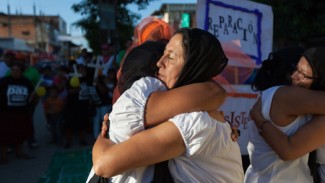
Recent developments in the country are challenging the taboos of publicly acknowledging sexual violence and paving the way to addressing the impact of conflict on women. Steadily, a broader conversation on a gender-sensitive approach to truth and accountability is burgeoning in Colombia, as well as on promoting women’s active participation in decision-making processes to redress victims of human rights violations.

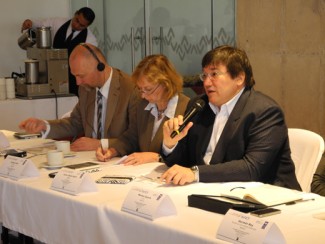
Media play an essential role in peace negotiations and post-conflict situations. In the highly polarized and politicized context of Colombia, the Gabriel García Márquez Foundation for New Ibero-American Journalism (FNPI) chose May 3, Worldwide Freedom of Expression Day, to bring together directors and editors of Colombia’s main news media to reflect on their role at a historic moment for the country: the government’s peace talks with the FARC, which represent a possible end to five decades of armed conflict.

For the last 50 years Cypriots have been living amid various forms of conflict between political leaders, communities and armed forces. Divisive re-tellings of key moments in these conflicts continue to be important to the politics of all communities on the island.

The People’s Representative Assembly of Indonesia passed on September 7, 2004, a bill creating a “Truth and Reconciliation Commission”, which is charged with clarifying abuses committed before 2000 and determining whether to award individualized amnesties for perpetrators and reparati...

ICTJ provides constructive comments on the draft Internal Rules for the Extraordinary Chambers in the Courts of Cambodia (ECCC). While the draft Internal Rules provide greater procedural clarity for the ECCC proceedings, ICTJ lists several concerns in five areas that must be focused o...

The South African Coalition for Transitional Justice (SACTJ) submits the following comments regarding the May 11, 2010 General Notice 282 published in the Government Gazette. The Coalition objects to the Notice 282 regulations on procedural, constitutional, and international law groun...

This report aims to help practitioners in the transitional justice field to understand the experience of establishing and operating hybrid courts and to address some common assumptions about these entities. To do so, it looks at hybrid or mixed courts in practice, drawing on experienc...

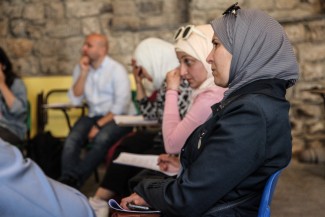
At the end of April in Syria, dozens of local residents in several cities and towns sat down together for the first time to finally speak about their experiences during the 14-year conflict that tore society apart and resulted in countless human rights violations. These community dialogues, organized by ICTJ in partnership with the Bridges of Truth project, provided a safe space for participants to share their stories and hardships, discuss their needs, and express their hopes for justice and reconciliation.

ICTJ, with the sponsorship of the United Natinos Rule of law Unit and the support of the Secretariat of the Assembly of States Parties (ASP) to the International Criminal Court (ICC), hosted a retreate entitlted "Complementarity After Kampala: The Way Forward" on October 28-29, 2010, ...

Reparations and development are generally conceptualized and approached independently, but for survivors and victims the demand for both often arises simultaneously. In practice, reparations and development are linked in specific ways. This paper analyzes these links in the context of...