


1526 results

The International Center for Transitional Justice (ICTJ) welcomes today’s verdict in Guatemala by the High Risk Court in the trial of former military dictator José Efrain Ríos Montt. The 86-year-old ex-general was convicted of genocide and crimes against humanity against the indigenous Mayan Ixil population during Guatemala’s Civil War. He was sentenced to a total of 80 years in prison. José Mauricio Rodríguez Sánchez, the co-accused, who headed military intelligence under Ríos Montt, was found innocent.

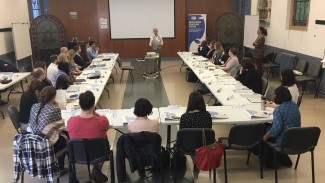
From Syria to Colombia and beyond, how do societies navigate the pursuit of justice in peace processes? That question animated ICTJ’s annual Intensive Course on Transitional Justice and Peace Processes, which this month gathered 31 participants from nearly 20 countries in Barcelona to discuss the place of justice in negotiations to end conflict. Go behind-the-scenes with our instructors and participants.

The first online debate hosted by the ICTJ on the role of media in transitional justice has come to a close. The debate aimed to illuminate issues around this complex relationship and was the first in a series ICTJ will host on topics on which there is no consensus in the field.

The International Center for Transitional Justice (ICTJ) decries the announcement that the country will seek to withdraw from the Rome Statute, the treaty that created the International Criminal Court and an international framework for fighting impunity for egregious crimes.

The International Center for Transitional Justice denounces the passage of Tunisia’s deeply flawed “Administrative Reconciliation” law, which grants amnesty to public officials who were involved in corruption during the dictatorship but who claim they did not personally gain from it.

ICTJ deplores the resolution of the African National Congress, at its National General Council meeting on Sunday, to withdraw South Africa from the International Criminal Court and lead an Africa-wide walkout from the court.

In these convoluted times, when terrible news dominates the headlines and overwhelms our hearts and minds, it is sometimes comforting to remember the words of Martin Luther King, Jr.: “The arc of the moral universe is long, but it bends towards justice.” News from Spain on recent progress toward justice for victims of fascism may offer some inspiration, and it is why I picked this story from the many unfolding around the world to comment on in this month's World Report.

Following the recent closure of ICTJ's office in Côte d’Ivoire, we caught up with Head of the Office Mohamed Suma and Senior Expert Cristián Correa to reflect on ICTJ’s work in the country and with victims, women, and youth, as well as the reasons why ICTJ has chosen to scale down its activities.

ICTJ has expressed deep concern over the criminal proceedings that resulted in the imposition of death sentences on 529 supporters of former President Mohamed Morsi in Egypt on Monday. The verdict, announced by a criminal court in Minya, came after a trial that lasted less than an hour, according to news reports.

On February 1, 2025, ICTJ facilitated a meeting between family members of the missing and detainees and Syria’s transitional president, Ahmed Al-Sharaa, and the minister of foreign affairs, Asaad Al-Shaibani, at the Presidential Palace in Damascus. Attendees presented a number of specific urgent demands related to the missing and forcibly disappeared, while President Ahmed Al-Sharaa underscored the government’s commitment to the issue.