


1526 results

ICTJ sat down with three prominent experts on restorative justice, to learn more about their experiences, restorative justice, and its role in transitional justice and Colombia.

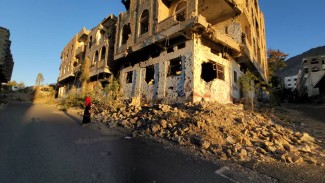
Yemen's nine-year conflict has devastated the country and created one of the world’s worst humanitarian crises. The regional upheaval stemming from the ongoing war on Gaza has created more obstacles on the country's already complex path toward peace and shifted attention away from the set of UN-brokered commitments agreed upon by the parties to the conflict in December 2023, which include a nationwide ceasefire. Amid these challenges, it is more imperative than ever to support civil society and victims and bring attention to victims’ grievances and needs.

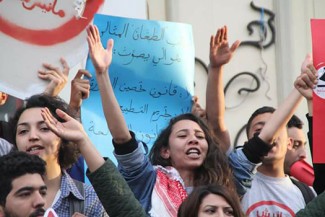
ICTJ's Virginie Ladisch spoke with Heythem Guesmi, a young Tunisian activist who is fighting systemic oppression, economic exclusion, and impunity that persist despite the Revolution’s initial success, and Thenjiwe McHarris, a young organizer working with Black Lives Matter in the United States—a movement whose urgency also stems from historic marginalization leading to widespread impunity and systematic failures in law enforcement.

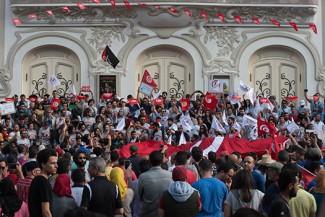
Victims of Tunisia’s dictatorship shared their stories publicly on November 17 in a historic moment for the country. The Truth and Dignity Commission (TDC) - charged with investigating gross human rights violations in the country since 1955 committed under the dictatorship - held its first public hearings in Tunis, gathering victims to testify to their experiences under dictatorship. The hearings present an essential opportunity for the country to confront its painful past. Since its inception in 2014, the TDC has received over 62,000 submissions and heard testimony from about 11,000 people.

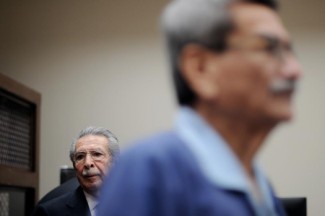
Four international legal and human rights groups are together urging all concerned to ensure that the current trial in Guatemala of former president Efrain Rios Montt on charges of genocide and crimes against humanity proceeds with due respect for judicial independence. The four are: the Open Society Justice Initiative, the International Center for Transitional Justice (ICTJ), the Center for Justice and International Law (CEJIL), and the Washington Office on Latin America (WOLA).

The decision of a judge in Guatemala City to send former military dictator Efraín Ríos Montt to trial on charges of genocide and war crimes is a watershed moment in the country’s complex journey towards a genuine respect for the rule of law. This genocide trial - the first genuine attempt anywhere to prosecute a former head of state in his own country on charges of genocide – has the potential to shatter a significant part of the wall of denial that surrounds Guatemala. For that to happen, the trial must be fair and free of intimidation, argues ICTJ Vice President Paul Seils in this op-ed.

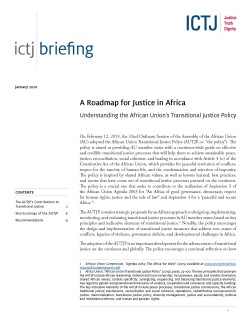
On February 12, 2019, the Assembly of the African Union adopted the African Union Transitional Justice Policy. The policy serves as a guide for member states on effective and credible transitional justice processes to achieve sustainable peace, justice, reconciliation, social cohesion...

PDF of the first page of the briefing paper "A Roadmap for Justice in Africa"

Development theory and practice to date has not engaged extensively with transitional justice. This paper explores tentative pathways to conceive of how development and transitional justice practices connect-from a development practitioner's point of view.

Youth activists in Tunisia have played a vital role in keeping corruption at the center of public debate since the country's revolution in 2011. Through decentralized, nationwide protest movements, young Tunisians have been calling for measures that root out systems of endemic corruption. ICTJ sat down with one youth leader to discuss her activism and views on Tunisia's transitional justice process.

Part of a series of practitioner-oriented publications by OHCHR, focused on the establishment and implementation of reparations programs. Download the PDF from the OHCHR website

Part of a series of practitioner-oriented publications by OHCHR, this report provides operational guidelines on the implementation of vetting programs within the broader context of institutional reform in post-conflict or post-authoritarian societies. Download the PDF from the OHCHR w...

Hybrid courts are defined as courts of mixed composition and jurisdiction, encompassing both national and international aspects, usually operating within the jurisdiction where the crimes occurred. Drawing on the lessons learned from hybrid courts created since 1999, this publication ...

This publication is intended to assist in the implementation of principles contained in international human rights documents and treaties. It is a practical tool to provide guidance on implementing reparations initiatives. Its focus is not on redressing single or isolated human rights...

This publication sets out basic considerations on prosecution initiatives. It is intended to assist United Nations field staff when advising on how to address the challenges of prosecuting perpetrators of crimes such as genocide, crimes against humanity and war crimes. It focuses on t...

This publication sets out basic principles and approaches to truth commissions and is intended to assist policymakers in advising on the development of truth-seeking mechanisms. It summarizes lessons learned from the experiences of over 30 truth commissions in the past two to three d...

This publication provides an operational framework for vetting and institutional reform. It is intended address the challenges of institutional and personnel reform in post-conflict States through the creation of vetting processes that exclude persons who lack integrity from public in...

ICTJ has released One morning they came to our community: Stories of political violence in communities of Peru, a compilation of victims’ stories about Peru’s internal armed conflict from 1980 to 2000. The stories constitute an important form of recognizing the truth, as well as a demand for justice and reparations.

The civil war in El Salvador officially ended 20 years ago, yet justice and accountability for past violations remain acutely absent. To launch a Spanish language podcast series focusing on Latin America ICTJ spoke with Carlos Dada, editor of the digital newspaper El Faro, about the critical role the media has played in uncovering the truth about past atrocities in El Salvador.

The appearance of Hosni Mubarak in the opening of his trial this week reassured millions of Egyptians that their revolutionary struggle was not in vain. But the truth about Mubarak’s ability to participate in his trial is still unclear. With the public doubting the court’s seriousness, Mubarak’s appearance could have been a political decision aimed at boosting confidence. If this is the case, the judiciary risks appearing politicized in the eyes of Egyptians.

The newly released United Nations report on strengthening the rule of law and transitional justice in conflict and post-conflict settings outlines progress made since issuing the landmark 2004 report and reaffirms transitional justice as a crucial component of the UN’s broader work on the rule of law.

Political choices made early on in the state-building process have contributed to the current governance and rule of law deficit in Afghanistan. European actions have been marked by a lack of coordination between political and development assistance as well as diverse – and sometimes ...

Efforts underway to address the 2008 Kenyan post-election crisis and the conditions that caused it have provided the country with a unique opportunity to address its long history of human rights violations.

A wide array of international donors are working with Timor-Leste to help support reform in the security sector. While many of these programmes have had a positive impact, donor-driven security reform agendas have been under-coordinated. Fortunately, this is beginning to change, as ...

In societies split dysfunctionally and violently along evident identity fault lines, the challenge of guaranteeing security requires not piecemeal reform of police and/or military organizations, but a holistic, "whole of governance" approach. How different identities are recognized an...

This multimedia project brings together voices of five Sierra Leoneans of different backgrounds reflecting on the legacy of the court as it nears the completion of its mandate.