1519 results

This year, Colombia commemorates the 20th anniversary of the Justice and Peace Law, which established the country’s first formal transitional justice mechanism. On this milestone anniversary, ICTJ reflects on the evolution that led to the groundbreaking law, the lessons that have been learned so far, and the challenges that lie ahead.

The Commission of Inquiry into Post-Election Violence (CIPEV) was the outcome of the Kenya National Dialogue and Reconciliation Accord of February 28, 2008, negotiated by Kofi Annan and the Panel of Eminent African Personalities, and its sister agreement of March 4, 2008, known as Age...

This document is a review of vetting programs that took place in two post-conflict (Bosnia and Herzegovina, and Liberia) and two post-authoritarian (Hungary and the Czech Republic) countries during the 1990s and early 2000s. It assesses the legacies of vetting and lustration processes...

This book presents a series of essays on truth and criminal justice in Peru. It aims to contribute to analysis on how to strengthen and consolidate democracy there. The essays pay particular attention to the interests of individual victims' of human rights abuses, analyzing individual...

This report analyzes the macro-criminality approach that was taken in Colombia’s Justice and Peace process and draws key lessons for the Special Jurisdiction for Peace. It examines how Law 1592 of 2012 and other regulatory instruments sought to move beyond a case-by-case method, prior...

Cover of Macrocriminality report

This study provides expert financial and operational analysis and information to help facilitate the establishment of an Independent National Commission for the Missing and Forcibly Disappeared in Lebanon, as envisaged in a draft consolidated bill now before the Lebanese Parliament. ...

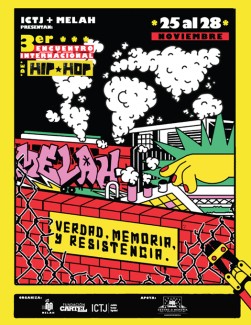
Bogotá, November 20, 2020—ICTJ and the Movement of Latin American Hip Hop Expressions have joined forces to cohost the third International Hip Hop Encounter, which will take place virtually this week from November 25 to November 28. The four-day online event will bring together artists and musicians from across Latin America and Africa along with activists, social leaders, and civil society representatives. The festival’s theme is the role of hip hop music and culture in uncovering truth, preserving memory, and resisting violence and oppression.

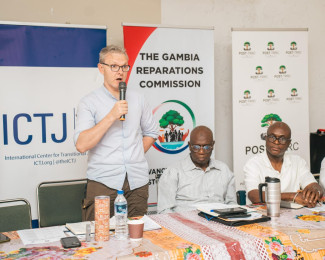
The trend of missing and disappeared persons due to conflict remains more prevalent than ever today. Many governments around the world have remained undeterred in their abuse of power to invade a home or community and remove persons deemed to be a threat. This intractable problem has received global attention largely due to the efforts of family members who often risk their lives in pursuit of the right to know and ‍‍to bury their loved ones.

Five years since the government of Indonesia and the Free Aceh Movement signed the Helsinki Memorandum of Understanding, key provisions for accountability for mass crimes have not yet been implemented. Attempts to avoid the difficult truths of Aceh’s recent history and to allow perp...

Although transitional justice processes are intended to help heal and restore society after conflict or authoritarian rule, marginalized groups often struggle to make their voices heard. These groups include those who have been displaced by conflict and, within that category, those wh...

On February 4, 2021, the International Criminal Court issued its judgment in the case of the Prosecutor v Dominic Ongwen. The ICC found Ongwen guilty of 61 counts of crimes against humanity and war crimes committed in Northern Uganda between July 1, 2002, and December 31, 2005. The verdict recognizes the enduring impact of the crimes on the victims, their families, and Ugandan society more generally.

This joint report by ICTJ and the Institute for Human Rights Study and Advocacy (ELSHAM-Papua) provides important insight into the ongoing debate on steps required to achieve a sustainable peace in Papua. The report reviews Papua's recent history within a transitional justice framewor...

This joint report released today by the International Center for Transitional Justice (ICTJ) and the Institute for Human Rights Study and Advocacy (ELSHAM-Papua) provides important insight into the ongoing debate on steps required to achieve a sustainable peace in Papua. The report reviews Papua's recent history within a transitional justice framework, and provides expert recommendations on truth seeking, justice, reparations, institutional reform, and enforcing the rights of women victims.

The government of Uganda has been slow to address and remedy serious human rights abuses committed against civilians throughout the country, despite its commitment under the Juba peace talks. This paper analyzes some of the underlying factors that seem to impede the implementation of ...

The role of police in society is to protect residents and enforce the rule of law. As a public institution, and particularly one whose function includes the state-sanctioned use of force, the effectiveness of the police depends on its integrity and legitimacy. When the police abuses its power, by brutalizing civilians and or engaging in corruption, it loses its credibility and the public’s trust. In Kenya, enforcement of measures to halt the spread of COVID-19 have been accompanied by acts of police brutality, of the kind that Kenyans have been through multiple times before.

To mark the launch of our new publication, "Forms of Justice: A Guide to Designing Reparations Application Forms and Registration Processes for Victims of Human Rights Violations", we sat down with Karl Gaspar to talk about his experience participating in the reparations process as a victim in the Philippines.

The term reconciliation has long been associated with the field of transitional justice and is often presumed to be one of its goals. At the same time, reconciliation has been both controversial and vague as a concept, giving rise to different understandings and approaches. This paper...

Authoritarian regimes frequently leave in their wake a series of negative legacies that have not received sufficient attention in the literature on transitions, and even less by transitional justice measures. This paper examines the political economy of transitions from authoritariani...

The principle of complementarity is central to the Rome Statute of the International Criminal Court (ICC). According to this principle, the ICC should assume jurisdiction only when states parties are unwilling or genuinely unable to carry out their own investigation or prosecution. Th...

This paper explores the power of a transitional justice approach to education reconstruction in post-conflict settings. Its central question is how the aims of transitional justice can guide educational reform processes after conflict or periods of massive human rights violations, wit...

Displacement was a major tactic used by armed groups during the brutal conflict in Liberia from 1989 to 2003. It is estimated that during this time, half the country’s population experienced displacement as a result of warfare. The large numbers of people forced from their homes meant...

This report provides an update on the developments in the Anfal trial before the Iraqi High Tribunal, including the trial of Saddam Hussein, his cousin Ali Hassan al-Majid, and five other co-defendants. This update focuses on the prosecution witness and documentary evidence phases of ...

Despite the enormous challenges, Sudanese civil society and other stakeholders are prioritizing transitional justice, acknowledging the need to address past injustices to end the cycle of conflict in their country. ICTJ continues to support them as they envision and design victim-centered, gender-sensitive, and inclusive strategies. Leading these efforts is ICTJ's Ilaria Martorelli. In this interview, she discusses the prospects for lasting peace, accountability, and repair in Sudan.

While not seen as sufficient in and of themselves as a means of reparation, the concept of “collective reparations” has been one of the ways in which reparation advocates have respond to practical challenges and to the overall complexity of responding to massive violations of human...

Of the 26 countries in the lowest bracket of the UN Development Programme’s 2008 Human Development Index, six have large victim communities expecting reparations as a result of truthseeking and criminal justice measures.