1533 results

This joint report released today by the International Center for Transitional Justice (ICTJ) and the Institute for Human Rights Study and Advocacy (ELSHAM-Papua) provides important insight into the ongoing debate on steps required to achieve a sustainable peace in Papua. The report reviews Papua's recent history within a transitional justice framework, and provides expert recommendations on truth seeking, justice, reparations, institutional reform, and enforcing the rights of women victims.

The government of Uganda has been slow to address and remedy serious human rights abuses committed against civilians throughout the country, despite its commitment under the Juba peace talks. This paper analyzes some of the underlying factors that seem to impede the implementation of ...

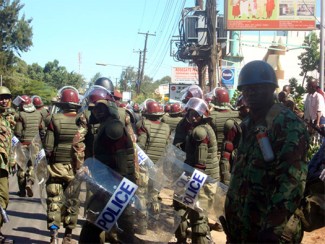
The role of police in society is to protect residents and enforce the rule of law. As a public institution, and particularly one whose function includes the state-sanctioned use of force, the effectiveness of the police depends on its integrity and legitimacy. When the police abuses its power, by brutalizing civilians and or engaging in corruption, it loses its credibility and the public’s trust. In Kenya, enforcement of measures to halt the spread of COVID-19 have been accompanied by acts of police brutality, of the kind that Kenyans have been through multiple times before.

To mark the launch of our new publication, "Forms of Justice: A Guide to Designing Reparations Application Forms and Registration Processes for Victims of Human Rights Violations", we sat down with Karl Gaspar to talk about his experience participating in the reparations process as a victim in the Philippines.

The term reconciliation has long been associated with the field of transitional justice and is often presumed to be one of its goals. At the same time, reconciliation has been both controversial and vague as a concept, giving rise to different understandings and approaches. This paper...

Authoritarian regimes frequently leave in their wake a series of negative legacies that have not received sufficient attention in the literature on transitions, and even less by transitional justice measures. This paper examines the political economy of transitions from authoritariani...

The principle of complementarity is central to the Rome Statute of the International Criminal Court (ICC). According to this principle, the ICC should assume jurisdiction only when states parties are unwilling or genuinely unable to carry out their own investigation or prosecution. Th...

This paper explores the power of a transitional justice approach to education reconstruction in post-conflict settings. Its central question is how the aims of transitional justice can guide educational reform processes after conflict or periods of massive human rights violations, wit...

Displacement was a major tactic used by armed groups during the brutal conflict in Liberia from 1989 to 2003. It is estimated that during this time, half the country’s population experienced displacement as a result of warfare. The large numbers of people forced from their homes meant...

This report provides an update on the developments in the Anfal trial before the Iraqi High Tribunal, including the trial of Saddam Hussein, his cousin Ali Hassan al-Majid, and five other co-defendants. This update focuses on the prosecution witness and documentary evidence phases of ...