


1537 results

International policymakers recognize that transitional justice is an important component of the 2030 Agenda for Sustainable Development, especially in countries affected by systemic violence, repression, and marginalization. Yet responses to massive human right violations often remain...

Cover image of the report Toward Victim-Centered Change: Integrating Transitional Justice into Sustainable Peace and Development. It features several black lines that lean slightly to the right. A single yellow at the far right stands straight.

This briefing paper focuses on establishing a credible approach to accountability and human rights in a post-conflict Syria. Looking ahead to an eventual resolution to the war, it recognizes that Syrian authorities and civil society, as well as the international community, will have t...

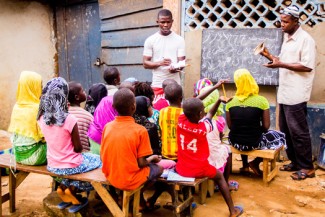
Kaneleng are women who cannot bear children or whose children died at an early age. At a two-day summit held in December 2018, 25 kaneleng received training on transitional justice concepts. They worked to develop songs, comedy, and dramas that they will use to present justice messages through their work as traditional communicators.

SEILS: ICTJ are delighted to host today a real giant in the world of political and legal struggle. Albie Sachs has not only played a huge and influential role in the development of the South African constitution but after being nominated by Nelson Mandela for 15 years in the new constitutional court...

This year marks the 20th anniversary of the publication of Children of Cain, the first book by writer and journalist Tina Rosenberg. ICTJ spoke with Rosenberg about how political violence has evolved in Latin America over the past 20 years, and the continuing need for accountability for past atrocities.

In this op-ed, ICTJ Vice President Paul Seils discusses how education can be used to address legacies of mass violence and dictatorship.

Transforming a Legacy of Genocide presents the findings of a November 2007 survey of visitors to Choeung Ek, a public memorial of one of Cambodia's notorious "killing fields" during the Khmer Rouge regime, where approximately 20,000 people were killed between 1975 and 1979. The survey...

This research report offers guidance on the application of a restorative justice framework in contexts of massive human rights violations, including its advantages and challenges. Based on the experiences of Colombia, Sierra Leone, Tunisia, and the Philippines, the study examines how ...

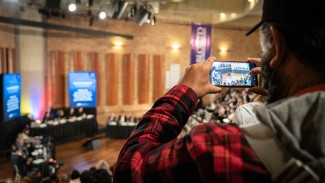
A man and audience member holds his phone to record proceedings of panel on the stage in front of him.

In 1996, six years after Nepal replaced its absolute monarchy with multi-party democracy, Maoist rebels launched an armed struggle that led to an estimated 13,000 deaths over the next decade. In November 2006 the rebels and government made peace, paving the way for the abolition of th...

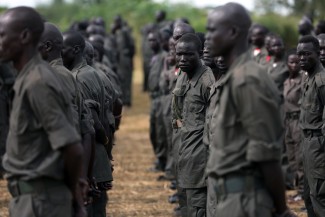
The recent move by the signatories to the Revitalized Agreement on the Resolution of Conflict in South Sudan (R-ARCSS) to extend the peace agreement’s life for another 24 months has not come as a surprise. While there have been some positive, though sporadic steps toward fulfilling the R-ARCSS, its...