


1537 results

Developing societies emerging from conflict and authoritarianism are frequently beset by poverty, inequality, weak institutions, broken infrastructure, poor governance, insecurity, and low levels of social capital. The same countries are also often the scene of massive human rights vi...

In collaboration with the Brookings-LSE Project on Internal Displacement, ICTJ’s Research Unit examined how transitional justice can be used to address the range of injustices associated with displacement and thereby serve as part of a comprehensive approach to the resolution of displ...

Transitional Justice is often pursued in contexts where people have been forced from their homes by human rights violations and have suffered additional abuses while displaced. Little attention has been paid, however, to how transitional justice measures can respond to the injustices ...

After periods of conflict and authoritarianism, education institutions often need to be reformed or rebuilt. But in settings where education has been used to support repressive policies and human rights violations, or where conflict and abuses have resulted in lost educational opportu...

This chapter examines the largely overlooked relationship between female ex-combatants, DDR, and transitional justice, with a particular focus on truth commissions. The potential of truth commissions to recognize women’s multiple and contradictory roles during armed conflict and to pu...

Transitional Justice and Georgia's Conflicts: Breaking the Silence examines the conflicts involving Georgia from a transitional justice perspective. Frichova argues that introducing this dimension into the public discourse in Georgia and its breakaway territories could help advance co...

In a society grappling with the legacy of the past, citizens must make informed judgements and disentangle the facts from the sticky web of political rhetoric, denial, and polarizing propaganda. To do so, they rely on one key agent of social change: the media. But how can transitional processes effectively partner with the media and engage key constituencies? And what happens when media play a decisively negative role in mediating information about war crimes?

This report summarizes the findings of an ICTJ research project on the contribution of transitional justice to prevention. Drawing from five country case studies, it contends that addressing the past can help to prevent the recurrence not only of human rights violations but also viole...

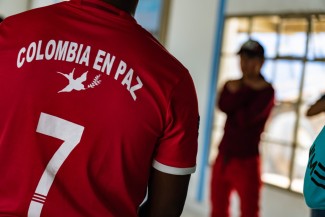
A young person with back facing the viewer is wearing a T-shirt that reads “Colombia in Peace"

The relationship between transitional justice and security system – or sector – reform (SSR)1 is understudied, yet both contribute to state-building, democratisation and peacebuilding in countries with a legacy of massive human rights abuse. Reforming the system to ensure security age...

Many of the situations that transitional justice has been called upon to address involve wholesale attacks on minority communities. MIP rights may be -- and in some cases have been -- articulated to strengthen claims for transitional justice, and produce outcomes in transitional justi...