1519 results

Though not a state party to the Rome Statute, Cote d’Ivoire accepted the jurisdiction of the ICC through an ad hoc declaration in April 2003, and in December of 2010—in the wake of the post-election crisis—reaffirmed that declaration. It has been more than one year since Cote d’Ivoire began a critical transition from a decade-long civil war that divided the country and led to widespread human rights violations, forced displacement, and loss of civilian lives and property.

Nearly three years after violence in Cote d’Ivoire claimed the lives of over three thousand civilians and displaced hundreds of thousands, victims have yet to receive adequate reparation for the harm they suffered. ICTJ convened victims’ organizations, civil society, government officers and others to assess how the country should move forward to ensure victims see their right to reparation fulfilled.

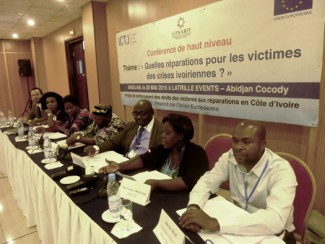
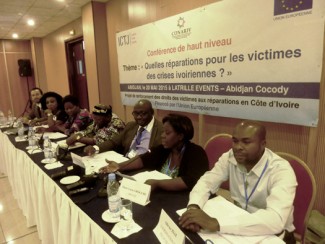
ICTJ recently facilitated consultations on reparations policy between victims of the Ivorian crisis and the National Commission for Reconciliation and Compensation for Victims in Abidjan, Côte d’Ivoire.

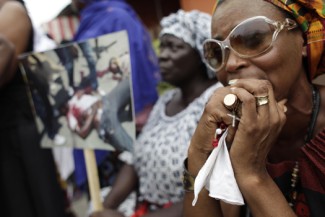
On January 15, 2019, victims of the 2010-2011 post-election violence in Côte d'Ivoire were shocked, yet again, to learn that the Trial Chamber I of the International Criminal Court in The Hague had acquitted former President Laurent Gbagbo and the former Youth Minister Charles Blé Goudé of crimes against humanity allegedly committed during the crisis.

The Ivoirian government has a critical opportunity to define and implement a reparations policy that responds to the needs of the most vulnerable victims of the political, military and social crises experienced by Côte d’Ivoire between 1999 and 2012, according to the International Center for Transitional Justice (ICTJ).

In Cote d’Ivoire, avenues for education system reform are limited. To help youth find their voice, ICTJ and UNICEF facilitated an innovative truth-telling project led by Ivorian young people themselves. The result: an exploration of the unique experiences of young people during the conflict, told through radio broadcasts, public discussions and reports to government officials.

As the United States and Colombia near the signing of a free-trade agreement and resolve differences over labor rights and other issues, the problematic extraditions of paramilitaries accused of savage crimes committed during the years of counter-insurgency remain far from the spotlight.

This Brief of Amici Curiae is respectfully submitted by several human rights and torture treatment organizations pursuant to Federal Rule of Appellate Procedure 29 and District of Columbia Circuit Rule 29. The Brief is filed in support of the Plaintiffs-Appellants and seeks the revers...

A new briefing paper from the International Center for Transitional Justice provides guidance for national courts issuing decisions on redress of human rights violations involving sexual violence. It encourages judges, advocates and prosecutors to consider the full range of possible forms of redress when ordering reparations for victims, to make use of relevant national and international decisions in interpreting domestic laws, and to pay particular attention to how sexual violence may affect different victims.

In the quest to bring perpetrators of massive crimes to justice, international courts should be considered only as a last resort. Efforts to establish rule of law require the development of national capacity to prosecute the most serious crimes. On 25 and 26 October 2012, leading international actors from the judicial, rule of law, and development sectors will convene at the Greentree Estate in Manhasset, New York for the third Greentree Conference on Complementarity. The meeting aims to examine the needs of and challenges to national prosecutions for the most serious crimes in four countries: Ivory Coast, the DRC, Colombia, and Guatemala.