
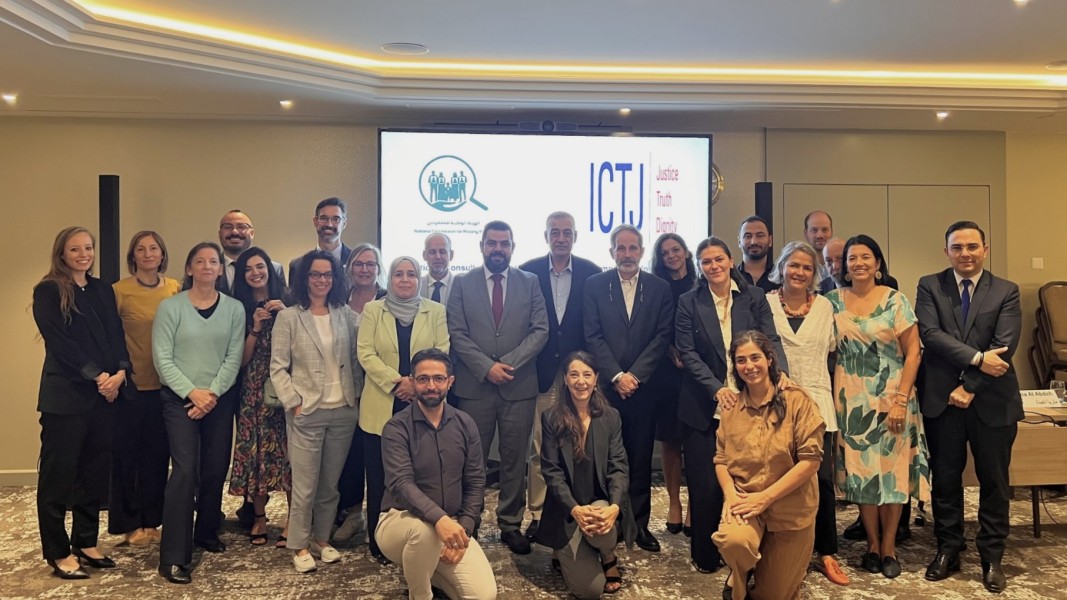
ICTJ, in collaboration with the Dutch Ministry of Foreign Affairs, recently convened the first international dialogue in Geneva in support of Syria’s two new justice commissions. From July 10 to 11, members of the National Commissions for Transitional Justice and for the Missing joined representatives of Syrian victim groups and experts and practitioners from around the world to discuss the present opportunities and challenges for peace and justice in Syria and how best to support the nascent institutions in fulfilling their mandates and advancing acknowledgment, truth, accountability, and repair.
“Reconstruction will surely take generations, but we must ensure that there will be justice and reparations,” asserted a civil society representative and member of the Bridges of Truth project.
The convening opened with the presentation of the new report “Our Pain Turned into Policy,” which summarizes the main observations offered by Syrians during community dialogues organized by ICTJ and the Bridges of Truth in April 2025 and identifies priority areas for action. In the discussion that followed, participants agreed on one key point: although there is hope for a more just Syria, the challenges ahead are significant.
Chief among the challenges is designing inclusive transitional justice processes. “Above all, we want to avoid selective justice, because that is worse than no justice at all," stressed one civil society representative. To fully address the unique needs of victims, such initiatives must recognize individual experiences shaped by gender, religion, and place of origin. They must also integrate a psychosocial support approach that considers the trauma victims and their families have experienced, provides them with appropriate care, guarantees they can participate in these processes safely and without risk of re-traumatization.
The conversation subsequently turned to the mandates of the two commissions, during which the respective presidents described their scope and fielded questions from participants.
The president of the National Commission for Transitional Justice, Mr. Abdel Baset Abdel Latif, outlined the institution’s priorities, including upholding the independence of its members. He moreover affirmed his commitment to an inclusive process that guarantees the active participation of all victims, women, and civil society. Recognizing that Syrian society will need to build robust, equitable institutions that genuinely serve the people from the ground up, he urged those in the room to have patience and called on the international community to collaborate closely with national and local state and civil society actors.
For his part, the president of the National Commission for the Missing, Dr. Mohammad Ridha Jalkhi, underscored the main institutional priorities—uncovering the fate of the missing including children and ensuring mass graves are properly preserved and excavated and the human remains found in them are identified and returned to the families. To this end, he said the commission must establish a rigorous methodology for its work.
The following day, participants explored the topic of the missing in greater depth, with experts from Colombia, Mexico, and Argentina and representatives of international organizations focused on the issue sharing technical advice and lessons learned with Dr. Ridha Jalkhi and his team. The discussions covered wide-ranging topics, including the collection and archiving of evidence, access to related information, the protection of mass graves and other sites, and the role of alleged perpetrators in the search for truth.
Participants unanimously agreed that collaboration with all families of the missing is essential to the success of the commission and to uncovering the fate of the missing more broadly. This includes families not affiliated with associations and who are frequently excluded from official mechanisms. As one expert aptly pointed out, “Families were looking for their loved ones before anyone else.” Therefore, they must be involved at every stage of the process since they will continue to grapple with their loss long after the commission closes its doors.
Participants also agreed that, while Syrian stakeholders can learn from other transitional justice contexts, they must develop a victim-centered process tailored to the country’s unique circumstances and that leverages their knowledge, capacity, and resources.
Ultimately, the discussions over the two days revealed a profound crisis of trust within Syria. The Syrian people have lost faith in their country’s institutions, the international community, and even one another. “It is essential to rebuild trust in institutions, but it is just as crucial to rebuild ties between people. They must be able to listen to and believe each other,” explained Nousha Kabawat, head of ICTJ’s Syria program. “But while this trust must be rebuilt patiently, it cannot be decreed; it must be cultivated through transparency, participation, and the effective recognition of everyone’s rights.”
Key to restoring the social fabric in Syria is a comprehensive, inclusive, victim-centered transitional justice process that acknowledges and investigates past crimes, holds perpetrators to account, and delivers justice and repair to victims. The establishment of the two commissions is a major step forward in this regard and offers a window of opportunity for meaningful justice and national healing.
However, as these commissions begin their mandates in earnest, it is important to remember how important it is for all actors—state, civil society, and the international community—to seize this opportunity and work together to build a just and inclusive society. “We cannot take this opening for granted. We have sadly witnessed the relapse of too many countries,” cautioned Fernando Travesi-Sanz, ICTJ’s executive director of ICTJ. “Today, as we return home full of hope, we must keep in mind the fragility of transitional justice processes and the efforts and vigilance required to finally achieve peace.”
_________
PHOTO: Attendees of the international dialogue in support of Syria’s justice commissions held in Geneva pause for a group photo on July 11, 2025. (ICTJ)

