
ICTJ, in collaboration with the Center for Media Integrity of the Americas, the Cyrus R. Vance Center for International Justice (Vance Center), and the New York City Bar Association, recently hosted a screening of the Colombian documentary Después del Frío ("After the Cold"). Coproduced by ICTJ and Colombian journalist María Jimena Duzán, with the support of the Embassies of Sweden and Norway in Colombia, the film paints an intimate portrait of a nation seeking healing and transformation, where the scars of the past give way to hope.
"Después del Frío offers more than a window into Colombia's conflict," said Jaime Chávez Alor, associate executive director of the Vance Center. "It gives voice to those who experienced its effects firsthand and whose perspectives shape the path toward reconciliation, through storytelling that is both personal and powerful."
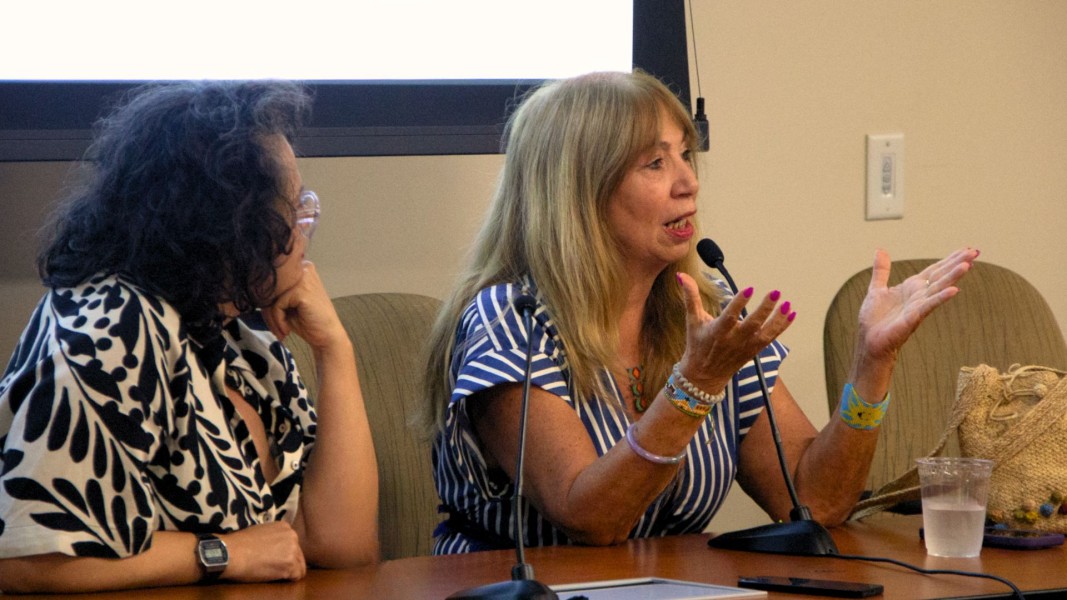
Held in New York on July 14, 2025, the event brought together members of the media and civil society, as well as representatives of the diplomatic community. Following the screening, a panel that included Duzán and the head of ICTJ’s office in Colombia Maria Camila Moreno, led a discussion and Q and A about the film and the peace process.
In 2016, the Colombian government and the country’s largest guerrilla group, the Revolutionary Armed Forces of Colombia–People's Army (FARC–EP), signed a comprehensive peace agreement that effectively ended nearly 60 years of armed conflict, one that left over 220,000 people dead and 125,000 others missing while it displaced millions more. Nine years later, while some armed groups are still active and criminal and politically motivated violence continues to haunt the country, many aspects of the agreement have been implemented, and Colombian society has opened up new spaces for dialogue and reconciliation.
The result of three years of research and encounters with Colombians across the country, the film considers these achievements in recent years as well as the challenges that lie ahead. To do so, it follows three Colombians whose lives were deeply affected by the conflict and the subsequent peace agreement: a survivor of a FARC kidnapping, a former army colonel, and a community leader fighting for democracy.
"I always thought the most important thing was understanding how a peace agreement could change the lives of ordinary Colombians. That's how this story began,” Duzán explained. “It began with searching for Colombians who had been affected by the conflict and whose lives had been changed by the peace agreement in one way or another."
The experiences of the three protagonists differ sharply, yet their testimonies reveal a shared commitment to national healing and reconciliation. Nowhere is this shared commitment clearer than in the willingness of some victims and ex-combatants to face one another in a series of acknowledgment hearings convened by Colombia’s Special Jurisdiction for Peace as well as in other less formal encounters. Together, the personal stories presented in the film suggest that the 2016 peace agreement may have fundamentally reshaped Colombian society.
During the panel discussion, participants expressed a similar sentiment about the peace agreement’s transformative impact. Colombia’s ambassador to the United Nations, Leonor Zalabata Torres, recalled that the government continues to implement the agreement and is working to end the violence that persists in some regions and address the root causes of conflict through its “Total Peace” policy. Meanwhile, former FARC combatant and signatory to the 2016 peace agreement Diego Tovar, who joined the event virtually, described it as “a benchmark that allows us to address not only the discussion around land issues, political participation, ending the conflict, and envisioning security in a comprehensive way… but also to make a profound commitment to center the victims that the conflict left behind.”
That said, participants recognized and discussed the obstacles that persist. For instance, some reforms promised under the peace agreement are still incomplete, and ensuring a strong state presence in conflict-affected regions remains a pressing task. While Colombia has achieved milestones once thought impossible, the path to durable peace is fragile and requires sustained political will and the active engagement of society at every level.
Después del Frío is in many ways a meditation on the promises, fulfilled or not, of Colombia’s transitional justice process. But, it also lays bare the immense effort required of all Colombians to not only achieve peace but sustain it. As Moreno reflected during the discussion, “We hope that the film can contribute to allowing the country to look into that painful mirror we hold, a mirror that shows us the horrors of which we are capable, but also what we are capable of when we connect on a human level and when we can also connect with hope.”
In the coming months, ICTJ will premiere Después del Frío to the general public on its YouTube channel.
____________
PHOTO: Colombian journalist María Jimena Duzán addresses attendees at a screening of Después del Frío in New York on July 14, 2025. (Margaux Cosson/ICTJ)

