

751 results

June 20, 2019 — In a tightly packed room at the United Nations, human rights experts gathered for a historic symposium to commemorate a dark chapter of South Korea’s past, the Jeju Uprising and Massacre that began on April 3, 1948, and continued until 1951, which Koreans now refer to as “the 4.3 Jeju” events. Over 100 persons, including notable academic panelists, human rights experts, journalists, diplomats, religious leaders, and peace activists attended the symposium.

The Gambian Truth, Reconciliation, and Reparations Commission (TRRC) started its operations in January 2019 with the public hearings of witnesses, victims, and perpetrators. It has already succeeded in having high-profile perpetrators testify publicly on their role in violations concerning several victims. But the question is, who should be at the center of truth telling?

Since the 1950s, the FARC had been present in the southern department of Caquetá in Colombia. The local population suffered from decades of armed confrontations between the FARC and the Colombian Army. This is the story of the collective memory project implemented with the El Pato municipal farmers’ association (AMCOP) in the El Pato-Balsillas farmer reserve zone.

In designing transitional justice in Armenia, policymakers, civil society activists, and international actors should remember those who have not had justice for so long: the families of those killed or injured in March 2008, the victims of torture and political detention, the mothers in black seeking the truth about why their soldier sons were killed, the old pensioners who live in cold and hunger, farmers and rural communities who need access to social services, and students and young citizens who saw that their hope for a better future required a revolution.

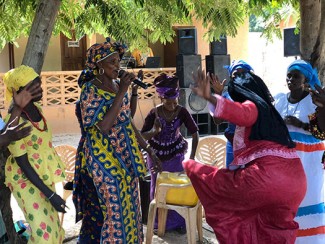
Banjul, June 12, 2019—“Never Again!” sings Awa Bling in her recently released song produced with the support of ICTJ. She is part of a movement of youth and prominent artists who are reclaiming this universal slogan by creating their own songs about transitional justice and bringing their voices to some of the most forgotten regions of The Gambia. Local and international fans can now access new music videos released on social media by five talented Gambian hip hop artists.

Regardless of how the world remembers Alex Boraine's legacy—or the success and shortcomings of the truth and reconciliation process in South Africa—history will recall that Boraine withstood his own, and his nation’s, transitions to cement his legacy as an architect for truth and reconciliation and a champion for justice for victims.

New York, June 3, 2019—Today, with just over a month to go before the 2019 UN High-Level Political Forum (HLPF) on Sustainable Development, ICTJ and its partners have released the Report of the Working Group on Transitional Justice and SDG16+, entitled “On Solid Ground: Building Sustainable Peace and Development After Massive Human Rights Violations.”

In the United States, the debate over a national reparations program for slavery and Jim Crow has until now encountered political opposition. However, transitional justice approaches at the community level are increasingly surfacing to address racial injustice. A handful of 2020 presidential candidates have come out in support of reparations for slavery. Recently, Georgetown University took center stage in this debate when its student body voted in favor of a student-led initiative to establish a fee that will fund education and health care programs for the descendants of 272 enslaved persons sold by the university in 1838.

ICTJ’s Gender Symposium, held on February 2 to 4, 2019, in Tunis, Tunisia, brought together fearless women leaders working in 8 countries to advance the needs of victims and to bring gender issues to the center of transitional justice processes. What was achieved? What experiences cut across these diverse contexts? Kelli Muddell and Sibley Hawkins reflect on these questions and more in this short podcast.

On April 11, 2019, Jaqy Mutere, cofounder and coleader of Grace Agenda, accepted an award from Physicians for Human Rights recognizing the work of the Survivors of Sexual Violence in Kenya Network and Grace Agenda, a leader in this movement. Jaqy cofounded Grace Agenda after she began working with women who, like her, had experienced sexual violence during the protests that erupted in Kenya after the contested December 2007 elections.