



629 results

This year’s Annual Emilio Mignone Lecture on Transitional Justice, coordinated by ICTJ and the Center for Human Rights and Global Justice at the NYU School of Law, focused on the intersection between transitional justice and international development.

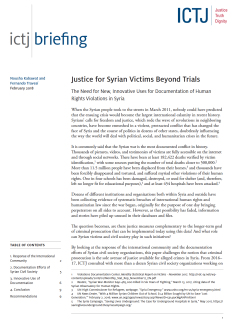
When the Syrian people took to the streets in March 2011, nobody could have predicted that the ensuing crisis would become the largest international calamity in recent history. Syrians’ calls for freedom and justice, which rode the wave of revolutions in neighboring countries, have be...

By looking at the documentation efforts of Syrian civil society organizations, this paper challenges the notion that criminal prosecution is the sole avenue of justice available for alleged crimes in Syria. Documentation could be used for important other avenues of justice, such as ac...

As the world marks August 30, the International Day of the Disappeared, we are reminded that forced disappearances and transitional justice share a common history. Indeed, processes working in concert that came to form the field of transitional justice were born from the search for truth and justice about the disappeared.

On June 25, President of the Philippines Rodrigo Duterte publicly proposed arming civilian supporters in his war on drugs. His statement comes barely a week after the International Criminal Court’s (ICC) outgoing prosecutor, Fatou Bensouda, announced her request to open an investigation into crimes against humanity related the Philippines’ war on drugs. This step has been long-awaited by victims of the drug war. Nonetheless, the ICC case should be part of a larger, more strategic fight for justice in which the needs, safety, and future of the predominantly poor families victimized by the drug war are central and just as important as naming, shaming, and prosecuting the perpetrators and abettors of these crimes.

What hope is there for justice for victims of atrocities in profoundly fractured societies, where systems of government have broken down and social and political divisions run deep? What is the role of transitional justice in forging peace in countries like Colombia, after decades of ...

This report presents the main findings of a multiyear research project conducted by the International Center for Transitional Justice on the challenges and opportunities of responding to serious and massive human rights violations in different contexts. The project commissioned 21 stu...

Kenya is just days away from the 2017 general election, but challenges dot the horizon, including the recent assassination of an election official. ICTJ's Chris Gitari calls for a strong, accountable security sector and the implementation of the Truth, Justice and Reconciliation Commission Report.

Many countries have endured a violent past or a dictatorship that left behind a trail of human rights violations. During transitions to peaceful societies or democracies, there is a need to address that painful past to ensure that the violations do not recur in future. While some countries have made or are making laudable efforts to deal with the atrocities of the past, others like Kenya are regrettably still at the phase of wishing the painful past away.

One year after its release, ICTJ presents a critical overview of the Final Report of Kenya’s Truth, Justice and Reconciliation Commission in a new study released today. The ICTJ study argues that, despite the controversies that surrounded the commission during its tenure, the Final Report should be read and treated with seriousness by those who support human rights and the rule of law in Kenya.