643 results

This report summarizes the key observations offered by Syrians during community dialogues in April 2025. Convened by Bridges of Truth, a collaboration of Syrian civil society organizations and ICTJ, the dialogues captured a wide spectrum of perspectives and experiences and provided va...

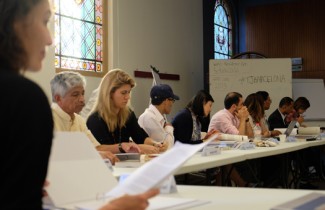
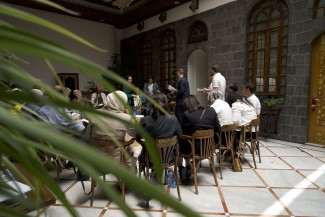
Some 20 people sit in chairs around a table located inside a courtyard.

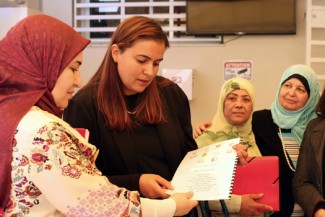
The voices of Tunisian women were in danger of being lost in the country's transitional process. Salwa El Gantri explains how one network of women's organizations made sure that did not happen by helping women find their voice and fight for justice.

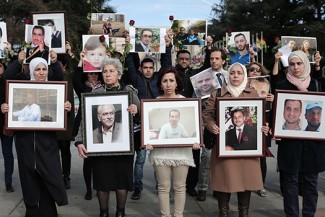
70-94% of the victims of enforced disappearances are men. But what happens to the women left behind? ICTJ's Amrita Kapur explains why women are uniquely impacted by the crime, and how transitional justice can help.

Pablo de Greiff, director of Research at ICTJ, has presented his candidacy for the role of Special Rapporteur for the Promotion of Truth, Justice, Reparation, and Guarantees of Non-Recurrence. This new position is being established by the United Nations Human Rights Council to bring greater attention to accountability for serious crimes and human rights violations.

For the past few months, ICTJ, along with our partners at the Center on International Cooperation at New York University, has been working on a comprehensive new policy paper on the situation of the many thousands of Syrians detained somewhere in the country’s vast network of prisons. The depravity that goes on inside these detention sites is already so appalling that it would have been hard to imagine when we started the project that the situation for the prisoners could get any worse. And then the COVID-19 pandemic hit, upending all of our preconceptions, and our lives, in ways none of us ever expected.

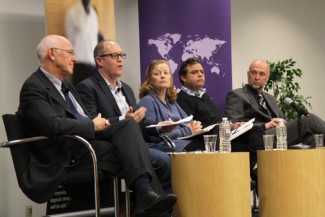
What happens when a state refuses to acknowledge the suffering of victims of mass atrocities? Or when the public celebrates perpetrators as heroes? Earlier this month, a panel discussion hosted by The International Center for Transitional Justice and New York University’s Center for Global Affairs grappled with the impact of denial on justice.

A panel of policy and media experts discusses women's experience in war and the responsibility of media covering their stories at the New York City premiere of a new documentary.

For seven years, ICTJ has partnered with the Barcelona International Peace Resource Center to provide an intensive course on truth commissions for practitioners and policymakers from around the world. The course aims to provide participants with practical knowledge that they could bring back and apply in their home countries.

Tunis, September 24, 2018—The International Center for Transitional Justice and the University of Birmingham launched Voices of Memory, an interactive exhibition inspired by a collective of nine Tunisian women from across the country and from different generations. The exhibition is the first collective testimonial of Tunisian women who experienced human rights abuses under the Ben Ali regime.

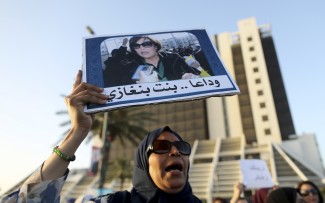
Libyan civil society organizations are fighting against all odds to support victims of human rights violations. In doing so, they themselves risk violence and do their work despite the visible and invisible pain they feel and the innumerable obstacles placed in front of them. Renewed global attention on the Libyan conflict and two new draft laws to protect activists and others may help.