350 results

ICTJ was pleased to host the newly elected United Nations Special Rapporteur on the promotion of truth, justice, reparations, and guarantees of non-recurrence, Fabian Salvioli (Argentina), at its New York office, where he discussed his vision and priorities.

The 2030 Agenda for Sustainable Development establishes an ambitious set of goals and targets, the achievement of which will be a formidable challenge for any country struggling with poverty and inequality. This challenge increases dramatically for countries currently experiencing or emerging from violent conflict.

ICTJ sits down with Syria Expert Nousha Kabawat to pause and reflect on the progress made so far in building capacity, raising awareness, and initiating high-level dialogue to address what remains a perilous situation.

ICTJ's Virginie Ladisch spoke with Heythem Guesmi, a young Tunisian activist who is fighting systemic oppression, economic exclusion, and impunity that persist despite the Revolution’s initial success, and Thenjiwe McHarris, a young organizer working with Black Lives Matter in the United States—a movement whose urgency also stems from historic marginalization leading to widespread impunity and systematic failures in law enforcement.

Nepal’s new local government structure – comprised of districts, municipalities, sub-municipalities, and wards formed within the new federal system under the 2015 Constitution – offers the possibility of some individualized redress for victims at the community-level. This article by Elena Naughton was published in the Kathmandu Post on May 6, 2018.

Although youth are key political and social stakeholders who have much to contribute to—and gain from—transitional justice processes, they often remain marginalized from such processes or are given only a limited and predetermined space in which to engage. In recent years, the peacebu...

These are especially challenging times for those of us who work to assist societies in dealing with a legacy of atrocities and massive human rights violations. Violent armed conflicts have increased in number, duration, and ferocity around the globe. Immense displacement and waves of ...

Members of parliament from political parties opposed to extending the work of Tunisia’s truth commission today voted to end the commission’s mandate. This came after parliamentarians from parties that support the extension walked out of the proceedings because their position is that the Organic Law that created the Truth and Dignity Commission (TDC or Instance Vérité et Dignité in French) authorized the TDC to extend its mandate. Earlier, the TDC had voted to extend its mandate by a year in order to complete its work. In a position paper distributed to members of parliament and civil society activists, ICTJ and the Victims’ Coalition for Dignity and Rehabilitation jointly said that they supported the extension of the TDC’s mandate, despite internal issues among its commissioners. ICTJ pointed out that other truth commissions elsewhere have sought and been given extensions in order to carry out key parts of their work, such as public hearings, or to complete writing their reports. Both ICTJ and the Victims’ Coalition said that an extension would allow the TDC to hold public hearings on marginalization and unemployment – which was one of the grievances that drove the Arab Spring in Tunisia. It would also give the Commission time to finalize its report and recommendations, including those on reparations.

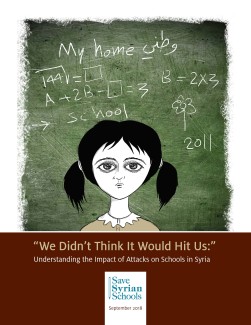
On March 22 in Geneva, we listened to the experiences of Syrians affected by attacks on schools. The Save Syrian Schools project presented the results of its one-year-long research—an unprecedented collaboration of 10 Syrian human rights organizations and the ICTJ.

Ten Syrian human rights organizations have been working in partnership with the International Center for Transitional Justice (ICTJ) to document and expose the long-term impacts of the attacks to and the destruction of schools in Syria. The project, Save Syrian Schools, will present its findings in a public hearing-style event in Geneva on March 22nd, at Forum Genève. The project works creatively to document human rights abuses and includes a public hearing-style event, multimedia, and high-level dialogue.