


350 results

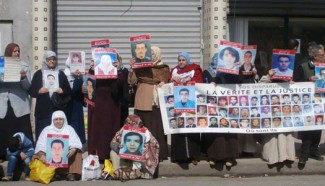
For more than two decades, some 40 women have been protesting every Wednesday against government inaction on the disappeared in front of Algeria’s official human rights commission. They stand on the sidewalk holding photos of their disappeared relatives — their children, fathers, and husbands — breaking the silence at a dangerous time in Algeria.

On International Women's Day, ICTJ Gender Justice Senior Associate Amrita Kapur highlights how insecurity affects women and is key to overcoming inequality across all dimensions of empowerment. "Without including institutional reform, we are condemning women to another century of inequality," she writes in this op-ed.

Earlier this month, the International Center for Transitional Justice (ICTJ) and its partners opened a two-week photo exhibit at the American University of Beirut’s Jafet Library, featuring vivid and often deeply personal photographs submitted for its “The War As I See It” youth photo contest. Students, professors, experts, and journalists packed into the library space lined with the 26 photographs in oversized frames.

A black-and-white photo of an open book pierced by a single bullet hole was chosen as the grand-prize winner of the International Center for Transitional Justice’s Youth Photo Contest, “THE WAR AS I SEE IT” in Lebanon. The photo, titled “Dominique,” was taken by Sibylle George, a 22-year-old architecture student at American University of Beirut.

The month of January has a particular significance in the Middle East and North Africa. It was the month when the Arab uprisings were sparked five years ago. It was also the month when the transitional justice process was inaugurated in Morocco, 12 years ago. What can be learned from Morocco’s experience?

Seeking justice for victims of enforced disappearance is crucial to building peace and preventing recurrence of violence in societies emerging from conflict, ICTJ President David Tolbert told members of the United Nations Security Council and other diplomats last week.

Today the trial begins in the “Sepur Zarco” case of acts of sexual violence and domestic and sexual slavery committed from 1982 to 1986 by members of the Guatemalan army against Maya Q’eqchi’ women and the forced disappearance of several men. This will be the first time in the world that a national court has tried a case of wartime sexual slavery case.

In the coming months, after launching a joint report on education and transitional justice with UNICEF, ICTJ will present an array of content on this important topic.

In this op-ed, ICTJ Vice President Paul Seils discusses how education can be used to address legacies of mass violence and dictatorship.

Young people in Kenya now have a new tool to help them learn about difficult periods in Kenyan history and discuss justice, democracy, leadership, and their role as Kenyan citizens.