605 results

When 26-year old Tunisian street vendor Mohamed Bouazizi incinerated himself on December 17, 2010, his act resonated across an entire region and sparked what is known as the Arab Spring. His cry echoed across the world because it was a universal call for justice, basic fairness, and equal treatment. Indeed, it was a call for the rule of law. In a new op-ed, ICTJ's President David Tolbert calls upon the UN General Assembly to prove its commitment to justice and the rule of law.

The War Crimes Chamber of Bosnia’s State Court is one of the most successful undertakings to address the legacy of mass atrocities in national courts. As this important institution finds itself under serious threat, the European Union must act quickly to put a stop to attempts of the Bosnian Serb political leadership to undermine Bosnia’s capacity to prosecute war crimes at state level.

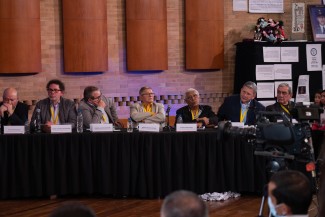
On November 28, 2023, ICTJ organized an international dialogue in Bogotá, Colombia, to share innovative strategies for advancing victims’ rights to redress for human rights abuses and for establishing more victim-centered development policies. The gathering also marked the official launch of ICTJ’s new report—Advancing Victims’ Rights and Rebuilding Just Communities Local Strategies for Achieving Reparation as a Part of Sustainable Development—which presents findings from a two-year comparative study of local efforts in Colombia, The Gambia, Tunisia, and Uganda to advance reparations.

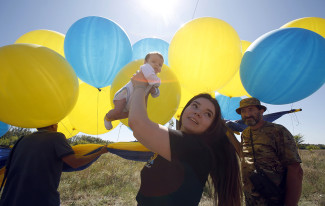
Despite earlier efforts to envision a national transitional justice policy, Ukraine remains overly cautious about establishing one. This report provides a robust substantiation of why Ukraine should revive its holistic transitional justice policymaking. In the first part, it debunks t...

A women holds up an infant in the air on sunny day outdoors, surrounded by yellow and blue balloons

This report asserts that dealing with past abuses in Myanmar is essential to achieving genuine progress on peacebuilding and economic development in the country. Conflict and high levels of political repression have racked Myanmar for more than half a century. Both President Thein Sei...

The International Center for Transitional Justice (ICTJ) and the Barcelona International Peace Resource Center (BIPRC) are pleased to announce an Intensive Course on Transitional Justice and Peace Processes, taking place in Barcelona, Spain, June 6 - 10, 2016. It will focus on practical examples of recent or paradigmatic peace processes where the question of justice formed a significant part of the negotiating context.

In this opinion piece, Lucia Withers argues that Nepal's elected parties and their representatives should not limit their discussions to the establishment of a truth commission or whether it will provide for amnesties and/or prosecutions. Rather, they should focus on designing policies that are more comprehensive and that would better serve the rights and needs of conflict victims and contribute to broader peace-building efforts.

ICTJ and the Bridges of Truth project are launching Tomorrow We Continue, a new short animated documentary that follows a young mother of two whose husband was detained and disappeared by security forces in Syria some years ago. The film takes the viewer on her journey as a refugee searching for safety in Berlin and depicts the daily struggles she encounters once settled as she tries to earn a living and care for her children while continuing to search for her husband. Since the uprising in Syria began in 2011, more than 100,000 people have been disappeared or arbitrarily detained. The families they leave behind may move to safer places as refugees, but the search for their loved ones persists wherever they go. This film is one of their stories.

A new book by ICTJ titled Justice Mosaics: How Context Shapes Transitional Justice in Fractured Societies examines the challenges of responding to massive human rights violations in different and difficult circumstances in today's world.

In this era of technological transformation, it is critically important to develop digital strategies for documenting human rights violations, analyzing data for accountability or reparations purposes, and safely advocating for human rights online. This is particularly true in contexts where victims, human rights actors, and members of the media live in fear. To this end, ICTJ has recently led trainings for human rights activists in conflict-affected countries on open-source investigation tools to help them do their work more effectively.