605 results

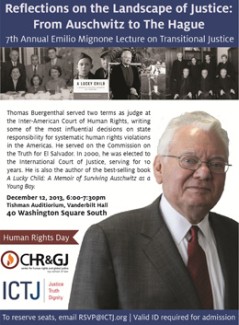
ICTJ and the Center for Human Rights and Global Justice at NYU School of Law are pleased to announce that Judge Thomas Buergenthal will be the speaker of the 7th Annual Emilio Mignone Lecture on Transitional Justice. Buergenthal is one of the world’s most distinguished jurists, whose name is synonymous with human rights and international justice. The lecture will be held on Thursday, December 12, from 6:00 to 7:30pm, in New York City.

Situation brief on the International Criminal Court's prosecution against Thomas Lubanga, the former leader of the Union des Patriotes Congolais (UPC) who has been charged with genocide and crimes against humanity. Due to problems with the prosecutor's proposed use of evidence, the tr...

On the International Day of the Disappeared, ICTJ Vice President Paul Seils argues that addressing the legacy of forced disappearances is both a moral imperative and a pragmatic necessity.

This study aims to communicate the perspectives, expectations, and needs of South Sudanese displaced persons to relevant policymakers and thereby inform the ongoing transitional justice efforts emanating from South Sudan’s 2018 revitalized peace agreement. It also provides lessons lea...

several women in colorful dresses crouch around an open fire pit, cooking food in a large pan.

Seeking justice for victims of enforced disappearance is crucial to building peace and preventing recurrence of violence in societies emerging from conflict, ICTJ President David Tolbert told members of the United Nations Security Council and other diplomats last week.

This briefing paper focuses on establishing a credible approach to accountability and human rights in a post-conflict Syria. Looking ahead to an eventual resolution to the war, it recognizes that Syrian authorities and civil society, as well as the international community, will have t...

SEILS: ICTJ are delighted to host today a real giant in the world of political and legal struggle. Albie Sachs has not only played a huge and influential role in the development of the South African constitution but after being nominated by Nelson Mandela for 15 years in the new constitutional court...

This research report offers guidance on the application of a restorative justice framework in contexts of massive human rights violations, including its advantages and challenges. Based on the experiences of Colombia, Sierra Leone, Tunisia, and the Philippines, the study examines how ...

A man and audience member holds his phone to record proceedings of panel on the stage in front of him.

In the span of only one month, Tunisia has witnessed the historic passing of a transitional justice law and adoption of a new constitution. A key actor in the country's transition is the media.

In collaboration with the Brookings-LSE Project on Internal Displacement, ICTJ’s Research Unit examined how transitional justice can be used to address the range of injustices associated with displacement and thereby serve as part of a comprehensive approach to the resolution of displ...