605 results

To commemorate the 20th anniversary of the Justice and Peace Law—which created Colombia's first transitional justice system—media outlet Verdad Abierta, the Friedrich Ebert Stiftung, and ICTJ partnered to produce an investigative four-part series in Spanish that critically assesses its legacy. ICTJ has now translated the first two installments into English.

This manual was created as part of the Framework Cooperation Agreement between the International Center for Transitional Justice and the Attorney General’s Office, with the aim of providing technical assistance to the National Unit for Analysis and Context (UNAC) and supporting the de...

This year, Colombia commemorates the 20th anniversary of Law 975, which established the country’s first transitional justice process, called Justicia y Paz (or Justice and Peace). With this anniversary top on mind, and as the current government engages with eight of the remaining armed groups in pursuit of its “Total Peace” strategy, ICTJ recently teamed up with podcast producers Sillón Estudios to create a four-part series that delves into the peace process with the AUC and considers key lessons learned.

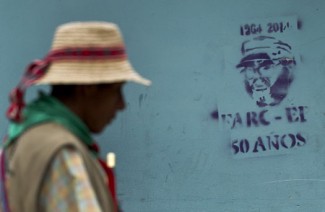
A new paper by the ICTJ on the peace negotiations in Colombia considers the competing goals of punishing members of the FARC who are deemed most responsible for committing serious crimes.

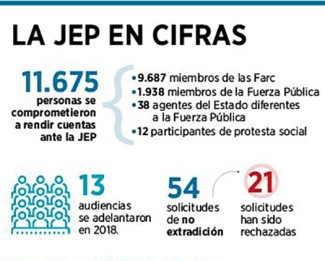
In little less than 10 months, Colombia has witnessed the creation of a completely new jurisdiction, the Special Jurisdiction for Peace (JEP). JEP has already opened two cases and three situations in its Chamber for the Acknowledgment of Truth and Responsibility.

ICTJ provides constructive comments on the draft Internal Rules for the Extraordinary Chambers in the Courts of Cambodia (ECCC). While the draft Internal Rules provide greater procedural clarity for the ECCC proceedings, ICTJ lists several concerns in five areas that must be focused o...

This report aims to help practitioners in the transitional justice field to understand the experience of establishing and operating hybrid courts and to address some common assumptions about these entities. To do so, it looks at hybrid or mixed courts in practice, drawing on experienc...

At the end of April in Syria, dozens of local residents in several cities and towns sat down together for the first time to finally speak about their experiences during the 14-year conflict that tore society apart and resulted in countless human rights violations. These community dialogues, organized by ICTJ in partnership with the Bridges of Truth project, provided a safe space for participants to share their stories and hardships, discuss their needs, and express their hopes for justice and reconciliation.

ICTJ, with the sponsorship of the United Natinos Rule of law Unit and the support of the Secretariat of the Assembly of States Parties (ASP) to the International Criminal Court (ICC), hosted a retreate entitlted "Complementarity After Kampala: The Way Forward" on October 28-29, 2010, ...

TUNIS—ICTJ hosted a conference on May 2 and 3 to address the current challenges facing Tunisia’s Specialized Criminal Chambers (SCC) as it proceeds to adjudicate cases of serious human rights violations committed under the former regime. The 90 guests who attended included members of Tunisia’s Truth...