425 results

ICTJ was pleased to host the newly elected United Nations Special Rapporteur on the promotion of truth, justice, reparations, and guarantees of non-recurrence, Fabian Salvioli (Argentina), at its New York office, where he discussed his vision and priorities.

Sparing almost no corner of the world from its wrath, the COVID-19 pandemic has now spread to every country. In an effort to slow the contagion, governments in most countries have been taking drastic measures requiring all residents other than essential workers to confine themselves in their homes, and shutting down vast sectors of their economies. The impact has been crushing. COVID-19 has profoundly affected every country where ICTJ currently works: Armenia, Colombia, Cote d’Ivoire, Ethiopia, Gambia, Kenya, Lebanon, Libya, Sudan, Syria, Tunisia, and Uganda. We recently caught up with ICTJ’s heads of country programs to learn more about the impact the pandemic is having on transitional justice and society more broadly.

Enforced disappearances continue to affect hundreds of thousands of people around the world. The hopes of Sri Lankan victims reached a peak in 2015, when President Maithripala Sirisena was elected on a centrist platform and a commitment to truth, justice, and reconciliation. Later that year, the Sri Lankan government agreed to a UN Human Rights Council resolution that offered a roadmap for the search for the missing and forcibly disappeared. To the dismay of many, however, the government has done little since to implement these commitments and to take the opinions of victims seriously.

On Thursday, January 13, 2022, the Higher Regional Court in Koblenz, Germany, convicted Anwar Raslan, a senior official in the Syrian government, for crimes against humanity. The landmark trial, the first ever to prosecute a member of Bashar al-Assad’s regime for such crimes, highlights a crucial component without which Raslan would never have been convicted: the role of victims in achieving justice.

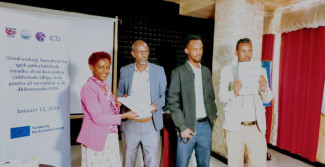
On July 28, 2025, the Somali Regional State Council passed a resolution designating April 6 as Victims’ Memorial Day, formally recognizing those who experienced violence and human rights violations across Ethiopia’s Somali Region. For years, victims and civil society actors, with support from ICTJ and other international partners, have persistently advocated for this acknowledgment, which marks a milestone in Ethiopia’s journey toward accountability and repair.

ICTJ is more than two decades old. At the time it was established, many of those who contributed to transitions in Argentina, Chile, Guatemala, South Africa, and the former Yugoslavia saw the value of a specialized organization that could draw from diverse national experiences to prov...

The cover of a report with the text, "2022-2027, Strategic Plan," with an image of people embracing underneath.

Over the last 15 years, the Ugandan government has implemented a series of recovery and reconstruction programs in Northern Uganda to address the social and economic devastation caused by the two-decade armed conflict in the region and set it on the path to sustainable peace. While these development programs alone cannot fulfill the state’s obligation to provide reparations to victims of human rights violations, if designed well, they can form a foundation upon which future reparations initiatives can be built.

This report presents findings from research on the needs and expectations of survivors of sexual and gender-based violence in The Gambia. Based on focus group discussions with survivors and other stakeholders, it analyses obstacles to, as well as opportunities to improve, survivors’ a...

Cover of the report on SGBV in The Gambia.

In the United States, the debate over a national reparations program for slavery and Jim Crow has until now encountered political opposition. However, transitional justice approaches at the community level are increasingly surfacing to address racial injustice. A handful of 2020 presidential candidates have come out in support of reparations for slavery. Recently, Georgetown University took center stage in this debate when its student body voted in favor of a student-led initiative to establish a fee that will fund education and health care programs for the descendants of 272 enslaved persons sold by the university in 1838.

Across Syria today, we continue to witness human rights violations and abuses that run counter to the very principles upon which the revolution was built. In particular, recent violence in the coast and Sweida has deepened the sense of fear and mistrust already felt by many communities. Meanwhile, Syria's new transitional justice commissions have been working hard to lay the foundations of their mandates. Now, at this critical juncture, they must show that they are ready to lead and first and foremost to serve victims.