
Over 100 representatives of civil society organizations, victims’ associations, government institutions, and diplomatic missions recently gathered in Addis Ababa to discuss what an inclusive transitional justice process in Ethiopia should look like. Participants explored best practices, local approaches, as well as persistent challenges to ensuring that those most affected by injustice play a central role in any process designed to address it.
The national convening also marked the closing of Dimts (“voice” in Amharic), an EU-funded initiative aimed at strengthening the capacity of civil society organizations and victims’ associations to meaningfully contribute to Ethiopia’s transitional justice process. Bringing together ICTJ, the Advocacy Center for Democracy and Development (ACDD), and 14 civil society organizations and nine victims’ groups from four regions across Ethiopia, the collaborative initiative sought to center grassroots experiences and lessons learned in policy and institutional discussions and promote victim-centered, gender-sensitive, and trauma-informed approaches to justice.
At the convening, representatives from conflict-affected communities described barriers to meaningful participation, including fear of retaliation, social stigma, displacement, economic hardship, lack of physical protection, and continuing psychological distress. “Justice is not a gift,” asserted a member of the Somali Region Victims Network.
Their experiences reinforced a key message: Meaningful participation requires more than consultations with victims. It requires safe and accessible spaces that provide physical protection, preserve confidentiality, and allow people to speak without fear of retaliation or re-traumatization.
Women’s participation emerged as a central concern. Participants from across Ethiopia stressed that women should not only be consulted but also hold leadership and decision-making positions throughout the transitional justice process.
Local actors shared approaches tested through Dimts, including women-only safe spaces, flexible methods for engaging communities in active conflict settings, and trust-building practices for communities skeptical of formal justice processes.
In one session, speakers presented the “return loop,” through which participants in women’s circles review and refine all messages, principles, and proposals before they are used in advocacy initiatives. This model seeks to guarantee that members of affected communities have influence on decision making. It reflects a broader lesson from Dimts: Participation becomes meaningful when community members can see the impact of their input on decisions.
Another panel focused on reparations, victims’ well-being, and inclusive institutions. Speakers emphasized that meaningful reparations must extend beyond financial compensation. Speakers also argued that mental health and psychosocial support should be an essential component of transitional justice, warning that repeatedly asking survivors to recount traumatic experiences without adequate psychosocial support can cause further harm.
In addition, participants discussed traditional and customary justice institutions. While these mechanisms can support truth-seeking and restorative healing, speakers noted that many exclude women from the decision making and should be reformed accordingly.
In the closing panel, representatives from Ethiopia’s Ministry of Justice, the Ethiopian Human Rights Commission (EHRC), the European Union, ICTJ, ACDD, and local civil society and victims’ groups considered how to implement the best practices and lessons learned through Dimts as part of a national process.
The minister of justice, H.E. Belayhun Yirga Kifile, reaffirmed the government’s commitment to a national transitional justice process. “Once the national dialogue is complete, transitional justice will be operationalized,” he told participants. “We are committed as one stakeholder, the government.”
The minister also recognized the contributions of civil society and victims’ groups, particularly the documentation, testimony, and community perspectives they have already collected. “You have started this work and made our work easier,” he said.
At the close of the convening, Dimts knowledge products, including research reports, policy briefs, advocacy tools, and community-generated recommendations, were formally handed over to representatives of the Ministry of Justice and the EHRC. This handover aimed to ensure that the project’s results inform Ethiopia’s transitional justice process.
While the convening marked the closing of Dimts, for the victims and civil society actors who took part in the project, it did not mean the end of their engagement. To the contrary, they consistently underscored their determination to complete the work they began.
As head of ICTJ’s Ethiopia program, Samrawit Tassew, said in her final remarks: “This is the closure of one chapter of our journey to healing and justice, but it will go on. The responsibility to keep victims at the center of justice continues.”
_________
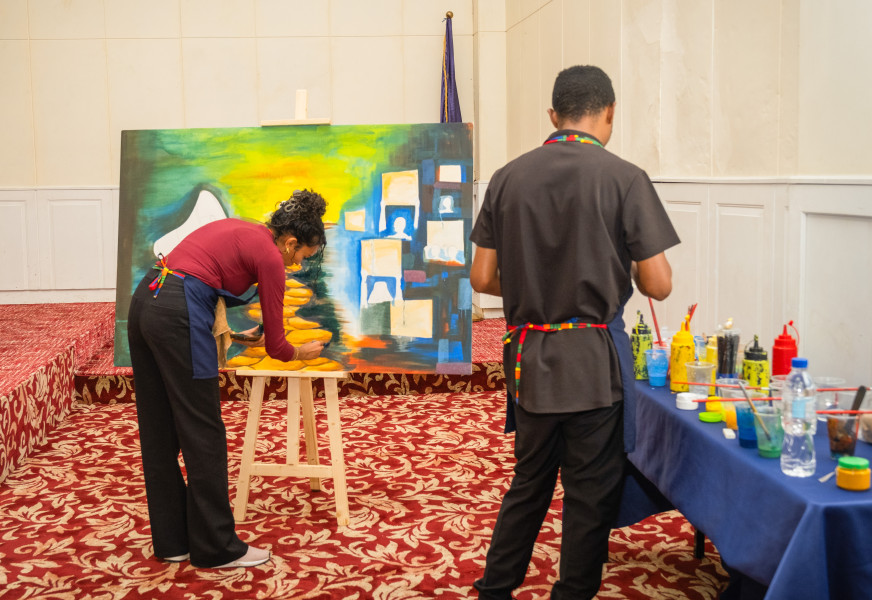
PHOTO: Local artists at the convening created a painting that captured broader themes that emerged during the discussions—such as dignity, healing, acknowledgment, inclusion, participation, and responsibility—and served as a lasting visual reflection on the collective journey toward justice and lasting peace. (Amen Frew Messele/ICTJ)