193 results

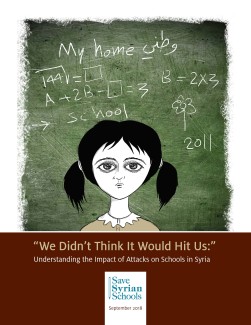
This report examines attacks on schools in Syria from multiple angles: from the legal implications of such attacks to the everyday impact on students, teachers, families, and society at large. It is the product of Save Syrian Schools, a collaborative project led by...

Kenyan media house Africa Uncensored has teamed up with the International Center for Transitional Justice (ICTJ) on a documentary that explores the Bulla Karatasi massacre that took place in the northern region of Garissa, Kenya, and its impact on communities in the North. The documentary will advance ICTJ’s efforts to partner with civil society on community-state dialogue initiatives, engage stakeholders around political and constitutional reforms stemming from the TJRC’s recommendations, and achieve redress for the legacy of state violence in Garissa and other communities in Northern Kenya.

A new short documentary film “Remember Me” tells a powerful story of two young women whose fathers were disappeared during the conflict in Bosnia and Herzegovina.

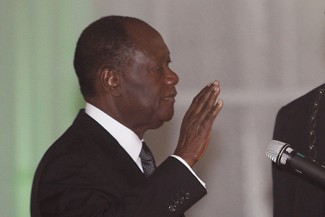
In this op-ed, ICTJ President David Tolbert argues that President Alassane Ouattara should use his second term as president to address widespread atrocities committed in Cote d'Ivoire's recent past.

Providing justice to victims of human rights abuses in fragile contexts such as the Central African Republic (CAR) is challenging for reasons related not only to the state’s stability, capacity, and political will, but also socioeconomic inequality in the country. This research report...

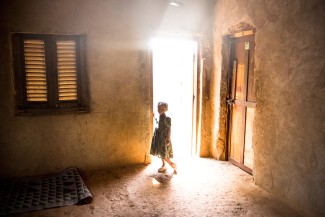
A young girl stands in the doorway to her house

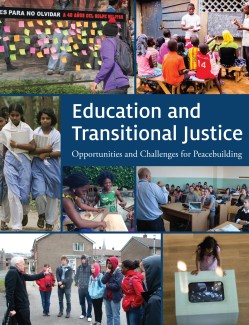
This report, part of a joint research project by ICTJ and UNICEF on the intersections of education, transitional justice, and peacebuilding, explores how a transitional justice framework can help to identify educational deficits relating to the logic of past conflict and/or repression...

The first piece in of our "Transitional Justice and Education" series examines the role of school systems in Bosnia and Northern Ireland.

In its primary findings, Kenya's Truth, Justice and Reconciliation Commission noted that women and girls have been subject to systematic, state-sanctioned discrimination in all spheres of their lives, and that the state has failed to take measures to end the practices that r...

On International Children’s Day, ICTJ reaffirms the importance of an active role of children and youth in transitional justice processes, such as truth-seeking, criminal accountability, and reparations programs. In the aftermath of societal upheaval, the voices of children and youth are often absent from peace negotiations and subsequent transitional processes. Though children and youth must be able to receive adequate care and necessary rehabilitation, they must not be regarded only as victims of massive human rights abuses: they are rights-bearing members of a society trying to confront the past, and active participants in the process of social change aiming for a new future. It is in the best interest of children and youth, as well as the societies in which they live, to participate in transitional justice processes, devised to reestablish rule of law and civic trust in the societies to which they belong.

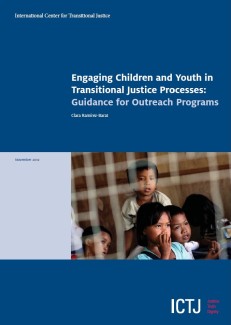
This report, produced jointly by ICTJ's Research Unit and the Children and Youth Program, is based on a comparative review of current and past efforts to reach out to children and youth as part of outreach programming for TJ measures. Drawing from the experiences of places as varied a...