


193 results

During this global pandemic, how do organizations such as ICTJ continue with their victim-centered and context-specific work, when their staff members cannot meet face to face with partners bilaterally, much less at organized convenings? The answer to these questions involves both rethinking how to use tools currently available and developing or finding new ones.

Victims in Nepal have been calling on the government for public consultation to ensure wider discussion, a process that would allow them to share their expectations, help them to comprehend the dense language of the proposed amendments and its many gaps. They needed to understand the dubious phrasing especially on issues of criminal accountability that created suspicion, instead of trust and legitimacy in the process.

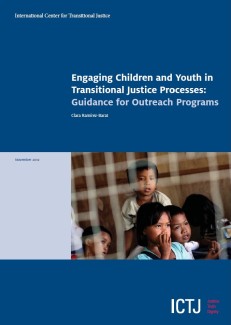
Children are particularly affected by conflict and mass atrocities and have a unique perspective on how those events impact their communities. This makes their participation in transitional justice processes essential for countries to genuinely make a break with the past and successfully address legacies of mass violence.

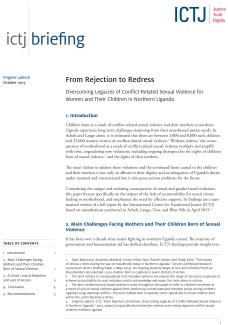
This paper examines the unique, enduring consequences of conflict-related sexual violence in northern Uganda, focusing specifically on the impact of the lack of accountability for sexual crimes leading to motherhood on girls and women, and on the children they bore as a result of viol...

Women and girls in Northern Uganda were victims of various forms of sexual violence, crimes whose consequences endure today. Many of the survivors bore children as a result of their violations, and the children born of wartime rape have been largely overlooked by the state. Meanwhile,...

When Janet Arach was still a schoolgirl, she was abducted by Joseph Kony’s Lord’s Resistance Army (LRA) in northern Uganda. During her eight years in captivity, she was forced to marry an LRA rebel and gave birth to two children. Read more on Janet's journey to become an agent of change for her community in Uganda.

Banjul, June 12, 2019—“Never Again!” sings Awa Bling in her recently released song produced with the support of ICTJ. She is part of a movement of youth and prominent artists who are reclaiming this universal slogan by creating their own songs about transitional justice and bringing their voices to some of the most forgotten regions of The Gambia. Local and international fans can now access new music videos released on social media by five talented Gambian hip hop artists.

From May 25 to June 1, 2025, ICTJ held a series of community dialogues in three rural regions of the Gambia on sexual and gender-based violence, including crimes committed during the Yahya Jammeh dictatorship. The dialogues brought together 122 individuals, including community leaders, victims, and young people, to share their experiences and discuss pathways for justice.

For the second consecutive year, ICTJ has been named among the world’s Top 100 NGOs by The Global Journal. ICTJ was also listed among the top three NGOs in the “Law and Justice” sector, acknowledging its unique role in assisting societies to strengthen the rule of law at the national level.

In most cases, to be imprisoned in Syria is to disappear. Tens of thousands of people, if not more, have been unlawfully taken prisoner or held incommunicado in the context of the Syrian conflict. This policy paper examines the dark reality of detentions in Syria, its impact...