225 results

This report is based on qualitative interviews with Central African refugees living in Chad and Cameroon, in which they were asked about their experience of displacement and their intentions and concerns regarding return, reconciliation, and justice. Refugees said that if peace a...

This paper explores how enforcement of international criminal law currently addresses socioeconomic and environmental crimes. It specifically examines current efforts to promote accountability for: (1) environmental war crimes and (2) property crimes and expropriation. The paper then ...

This study, carried out in partnership with Aulas de Paz and Universidad Santo Tomás, explores experiences of acknowledgment of responsibility under Colombia’s Justice and Peace Law. Drawing on interviews with victims, former combatants, and judicial officials, it identifies key lesso...

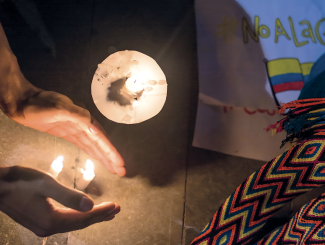
A person lights a candle during an anti-war protest in Barranquilla, Colombia.

Gender-based violence, including sexual violence was a common feature of the 10-year-long armed conflict between the security forces and the Communist Party of Nepal – Maoist (CPN-M), yet few individual incidents were reported.

While Afghanistan goes through tremendous transition, it is important for justice and reconciliation actors to build transitional justice and gender initiatives based on experiences in other postconflict contexts.

ICTJ’s Middle East and North Africa Program, in partnership with the Arab Institute for Human Rights, the Tunisian League for Human Rights, and the Office of the High Commissioner for Human Rights, convened an international conference entitled “Addressing the Past, Building the Future...

This report examines the gender sensitivity of Uganda’s National Transitional Justice Policy (NTJP) and its potential to deliver inclusive justice for victims of conflict. While the NTJP represents a significant policy achievement, gaps in implementation, participation, and gender inc...

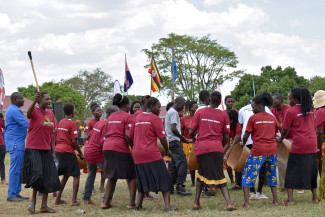
A large group of women dance in circle formation outdoors

Invoking the principle of universal jurisdiction opens the door to the possibility of some accountability in circumstances where justice is not possible in countries where the crimes took place. This study considers the challenges facing the exercise of universal jurisdiction and asse...

This comparative study examines strategies used by local actors to help operationalize reparations for victims of widespread human rights violations, while highlighting the synergies between these efforts and sustainable development. It is based on the fieldwork of ICTJ and its partne...

A women in colorful African dress holds a megaphone to her mouth

Counterterrorism detainees held in U.S. custody were subject to widespread abuses, including prolonged, arbitrary detention, physical and sexual abuse, enforced disappearance by way of the secret transfer of prisoners to undisclosed locations (“extraordinary rendition”), and other cru...