475 results

The taboo around sexual violence against men and boys can leave victims in the shadows, write ICTJ's Kelli Muddell and Sibley Hawkins. Without acknowledgment of these crimes, efforts to address injustices of the past will be hard-pressed to develop inclusive and effective responses.

Issoumaila Touré grew up during Côte d'Ivoire’s devastating First Civil War (2002-2007), watching his community be torn apart by political manipulations and ethnic differences. When his country once again descended into civil war following the 2010 presidential elections, Issoumaila, then a young man in his early 20’s, came to a major crossroads in his life.

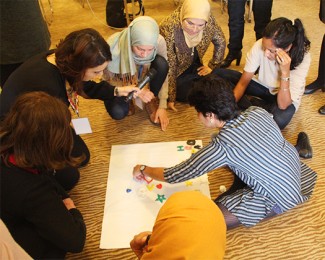
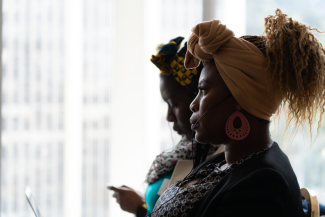
ICTJ’s Gender Symposium, held on February 2 to 4, 2019, in Tunis, Tunisia, brought together fearless women leaders working in 8 countries to advance the needs of victims and to bring gender issues to the center of transitional justice processes. What was achieved? What experiences cut across these diverse contexts? Kelli Muddell and Sibley Hawkins reflect on these questions and more in this short podcast.

NEW YORK, February 2, 2016 – A short documentary film depicting the devastating effects of stigma and discrimination against children born of wartime sexual violence, and their mothers, in northern Uganda was released today by the International Center for Transitional Justice (ICTJ) and MediaStorm....

When 26-year old Tunisian street vendor Mohamed Bouazizi incinerated himself on December 17, 2010, his act resonated across an entire region and sparked what is known as the Arab Spring. His cry echoed across the world because it was a universal call for justice, basic fairness, and equal treatment. Indeed, it was a call for the rule of law. In a new op-ed, ICTJ's President David Tolbert calls upon the UN General Assembly to prove its commitment to justice and the rule of law.

On November 28, 2023, ICTJ organized an international dialogue in Bogotá, Colombia, to share innovative strategies for advancing victims’ rights to redress for human rights abuses and for establishing more victim-centered development policies. The gathering also marked the official launch of ICTJ’s new report—Advancing Victims’ Rights and Rebuilding Just Communities Local Strategies for Achieving Reparation as a Part of Sustainable Development—which presents findings from a two-year comparative study of local efforts in Colombia, The Gambia, Tunisia, and Uganda to advance reparations.

The International Center for Transitional Justice (ICTJ) and the Barcelona International Peace Resource Center (BIPRC) are pleased to announce an Intensive Course on Transitional Justice and Peace Processes, taking place in Barcelona, Spain, June 6 - 10, 2016. It will focus on practical examples of recent or paradigmatic peace processes where the question of justice formed a significant part of the negotiating context.

ICTJ is pleased to announce an intensive course on transitional justice and peace processes to be held in Barcelona, Spain on October 9-13. Applications are now open.

This report focuses Liberia's Comprehensive Peace Agreement (CPA) of 2003. It examines many key decisions that were made in creating the CPA, and centers on questions of justice, accountability and the rule of law. It notes developments in the four years after the CPA was signed, an...

This report focuses the Lomé Accord of 1999, that ended the Sierra Leone's 10 year civil war. It examines the negotiation dynamics influencing its creation and the impact of the accord from 1999 to 2007. The peace accord is often remembered for its unconditional amnesty provisions, wh...