480 results

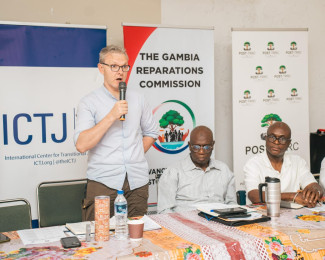
The establishment of the Reparations Commission in April 2025 and the recent appointment of British barrister Martin Hackett in April 2026 as The Gambia’s first special prosecutor represent crucial and long-awaited steps in the country’s transitional justice process. But to succeed, both require sustained public, political, and financial support.

On February 29, 2024, The Gambia-Economic Community of West African States Joint Technical Committee held its inaugural meeting on the establishment of a hybrid court to hold to account those responsible for gross human rights violations committed in the country between July 1994 and January 2017 during the dictatorship of former President Yahya Jammeh. Such an internationalized court presents an opportunity to deliver criminal accountability to the victims and Gambian society as whole. It is also just the latest step in The Gambia’s transitional justice journey.

Document from the High Court of South Africa regarding a case on enforced disappearances.

This paper assesses the impact of the International Criminal Court (ICC) on conflicts in Sudan and the Democratic Republic of Congo (DRC). The Sudanese government challenged and undermined the jurisdiction of the ICC from the start. Conversely, the leading actors in the DRC supported ...

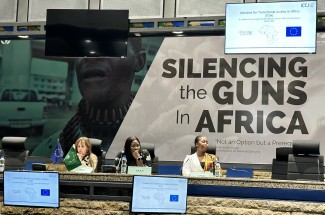
On October 25, the African Union (AU) and European Union officially launched their joint Initiative for Transitional Justice in Africa (ITJA) in Addis Ababa. The project will take place over a three-year period and will promote national transitional justice processes in Africa, in line with the AU Transitional Justice Policy and its roadmap. The ITJA has several unique features that, if embraced and advanced by all actors, have the potential to trailblaze a new and inspiring path to peace, justice, and sustainable development on the African continent.

The Commission of Inquiry into Post-Election Violence (CIPEV) was the outcome of the Kenya National Dialogue and Reconciliation Accord of February 28, 2008, negotiated by Kofi Annan and the Panel of Eminent African Personalities, and its sister agreement of March 4, 2008, known as Age...

Bogotá, November 20, 2020—ICTJ and the Movement of Latin American Hip Hop Expressions have joined forces to cohost the third International Hip Hop Encounter, which will take place virtually this week from November 25 to November 28. The four-day online event will bring together artists and musicians from across Latin America and Africa along with activists, social leaders, and civil society representatives. The festival’s theme is the role of hip hop music and culture in uncovering truth, preserving memory, and resisting violence and oppression.

On February 4, 2021, the International Criminal Court issued its judgment in the case of the Prosecutor v Dominic Ongwen. The ICC found Ongwen guilty of 61 counts of crimes against humanity and war crimes committed in Northern Uganda between July 1, 2002, and December 31, 2005. The verdict recognizes the enduring impact of the crimes on the victims, their families, and Ugandan society more generally.

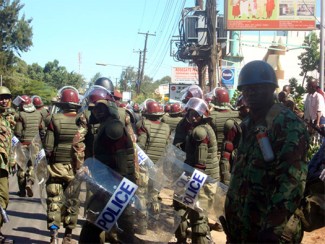
The role of police in society is to protect residents and enforce the rule of law. As a public institution, and particularly one whose function includes the state-sanctioned use of force, the effectiveness of the police depends on its integrity and legitimacy. When the police abuses its power, by brutalizing civilians and or engaging in corruption, it loses its credibility and the public’s trust. In Kenya, enforcement of measures to halt the spread of COVID-19 have been accompanied by acts of police brutality, of the kind that Kenyans have been through multiple times before.

The term reconciliation has long been associated with the field of transitional justice and is often presumed to be one of its goals. At the same time, reconciliation has been both controversial and vague as a concept, giving rise to different understandings and approaches. This paper...