194 results

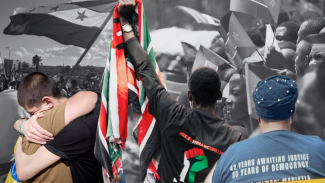
George Floyd’s death reignited existing anger over American society’s deep and festering racial wounds. His death triggered significant social uprisings that have challenged the methods of policing that have emerged over the course of several decades. With a growing awareness of polic...

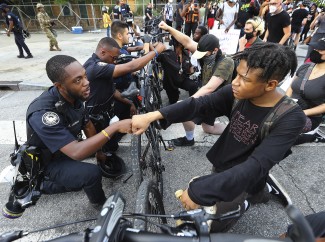
Three police officers kneel with several protesters at a demonstration.

With the inauguration of Colombia’s new president last month, optimism for the country’s ongoing transitional justice process is at a high. Newly elected President Gustavo Petro has strongly affirmed his commitment to the implementation of the peace agreement and ensuring the institutions it created...

This year, Colombia commemorates the 20th anniversary of the Justice and Peace Law, which established the country’s first formal transitional justice mechanism. On this milestone anniversary, ICTJ reflects on the evolution that led to the groundbreaking law, the lessons that have been learned so far, and the challenges that lie ahead.

This report analyzes the macro-criminality approach that was taken in Colombia’s Justice and Peace process and draws key lessons for the Special Jurisdiction for Peace. It examines how Law 1592 of 2012 and other regulatory instruments sought to move beyond a case-by-case method, prior...

Cover of Macrocriminality report

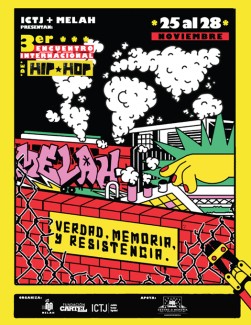
Bogotá, November 20, 2020—ICTJ and the Movement of Latin American Hip Hop Expressions have joined forces to cohost the third International Hip Hop Encounter, which will take place virtually this week from November 25 to November 28. The four-day online event will bring together artists and musicians from across Latin America and Africa along with activists, social leaders, and civil society representatives. The festival’s theme is the role of hip hop music and culture in uncovering truth, preserving memory, and resisting violence and oppression.

The trend of missing and disappeared persons due to conflict remains more prevalent than ever today. Many governments around the world have remained undeterred in their abuse of power to invade a home or community and remove persons deemed to be a threat. This intractable problem has received global attention largely due to the efforts of family members who often risk their lives in pursuit of the right to know and ‍‍to bury their loved ones.

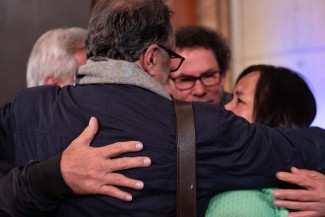
On June 21-23, Colombia’s Special Jurisdiction of Peace (JEP) held its first acknowledgment hearing on the taking hostages, serious deprivation of liberty, and other concurrent crimes (known as Case 01) in Bogotá. Seven former leaders of the guerrilla group Revolutionary Armed Forces of Colombia—People’s Army (FARC-EP) acknowledged their command responsibility for the kidnapping crimes that were the FARC-EP’s policy from 1993 to 2012 in the presence of victims, JEP officials, civil society representatives, and members of the press. This hearing marks the first time ever FARC-EP leaders publicly acknowledged their role in such systemic crimes. A decisive step in the country’s restorative justice process, it would not have been possible without years of preparation.

On February 26, 2020, the International Center for Transitional Justice and NYU Law’s Center for Human Rights and Global Justice welcomed former President of Colombia and Nobel Peace Prize Laureate Juan Manuel Santos for a conversation on the role of transitional justice in peace negoti...

The field of transitional justice is increasingly recognizing the relevance of mental health and psychosocial support (MHPSS) in contexts of massive human rights violations. Despite growing advocacy and awareness at the global policy level, however, the field lacks a systematic approa...

an image of colorful painting featuring a young girl

This study presents reflections on the peace negotiations between the Colombian government and the United Self-Defense Forces of Colombia between 2003 and 2006. It seeks to contribute to strategies for negotiating with or subduing illegal armed groups, as well as for the general pursu...

In the foreground is a large pile of military rifles. In the back stand a regiment of paramilitary fighters in army fatigues.