66 results

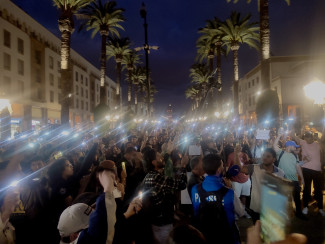
The death of eight women in childbirth at a hospital in Agadir this past August sent shockwaves through Morocco. The news crystallized national anger over deteriorating public services as well as persistent high unemployment and corruption. Years of frustration erupted into the streets as thousands of mostly young Moroccans gathered in cities and towns across the nation to protest and to demand accountability and institutional reform.

About the Project There are few crimes with such devastating and far-reaching impacts as enforced disappearance. Innocents taken from their homes vanish to secret locations known only to the perpetrators. Imprisoned, tortured, and often killed for dubious reasons, their disappearance l...

The resignation and indictment of President Otto Pérez Molina for corruption was a significant victory over impunity in Guatemala. In an interview with journalist Carlos Dada, we discussed how recent developments in Guatemala could impact other countries in Central America, such as Honduras and El Salvador.

This joint report by ICTJ and the Kofi Annan Foundation explores common assumptions about why truth commissions are created in the wake of armed conflict and what factors make them more likely to succeed – or fail. It arises from a high-level symposium hosted by the two organizations ...

In the quest to bring perpetrators of massive crimes to justice, international courts should be considered only as a last resort. Efforts to establish rule of law require the development of national capacity to prosecute the most serious crimes. On 25 and 26 October 2012, leading international actors from the judicial, rule of law, and development sectors will convene at the Greentree Estate in Manhasset, New York for the third Greentree Conference on Complementarity. The meeting aims to examine the needs of and challenges to national prosecutions for the most serious crimes in four countries: Ivory Coast, the DRC, Colombia, and Guatemala.

The Documentation Affinity Group (DAG) was established in 2005 by ICTJ and five partner organizations as a peer-to-peer network with a primary focus on human rights documentation. Documenting Truth collects the best practices derived from the work of the DAG organizations in Cambodia,...

Enforced disappearances are among the cruelest of crimes. To the kidnapping, torture, and in many cases, murder of the victim, perpetrators intentionally create fear and uncertainty about the fate of the missing person. Although men are predominantly targeted, the impact on women is severe and lasting.

ICTJ partnered with the Center for Global Affairs at New York University to explore how political will of international and national actors impacts national war crimes proceedings. The panel examined four diverse country scenarios - the Democratic Republic of the Congo, Serbia, Iraq, and Guatemala.

Forced disappearance is a crime against humanity. The decisions made by politicians and officials authorizing such practices in different countries cannot be justified legally or morally. They must be held to account and be shown for what they are: enemies of a civilized society.

On Tuesday, March 19, the genocide trial of General Efraín Ríos Montt began at the High Risk Tribunal in Guatemala. To talk about this historic development in Guatemala’s pursuit of accountability we talk with us one of the key players: Guatemalan Attorney General Claudia Paz y Paz Bailey
