

480 results

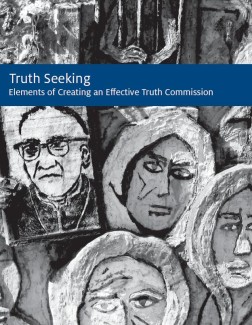
This publication provides an overview of the essential best practices guiding the main aspects of a truth commission, answering basic questions relating to its goals, powers, operations, framework, protections for commissioners and witnesses, and reporting. Its intention is to provide...

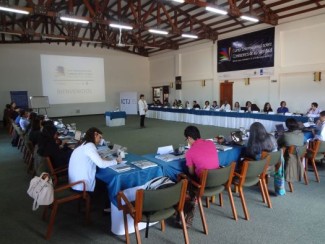
Nearly a decade after Colombia’s first transitional justice mechanisms were created, the country is now weighing options for the establishment of an official truth commission. To examine and inform these options, the International Center for Transitional Justice is hosting the International Course on Truth Commissions from March 11-15, 2013, in Villa de Leyva, Colombia. The course will be modeled after ICTJ’s international Intensive Course on Truth Commissions, which has been held for five consecutive years.

From February 27-March 1, leading indigenous rights activists from around the world will join their counterparts and other experts at Columbia University to discuss access to truth, justice, and reconciliation for indigenous peoples.

In this edition of ICTJ's Program report, Kelli Muddell, director of ICTJ's Gender Justice program, reflects on ICTJ’s vision of gender justice, the challenges facing survivors of sexual and gender-based violence in times of transition, and how ICTJ is working to address inequality in countries like Colombia, Nepal, and Tunisia.

The government of Uganda should work to institute comprehensive reparations for victims of the war against the Lord's Resistance Army (LRA). So states a new report by the International Center for Transitional Justice (ICTJ) and the Justice and Reconciliation Project (JRP).

There is now an opportunity to design and implement a reparations program for victims of human rights and humanitarian law violations in Uganda. As with other countries emerging from conflict, the contours of a Ugandan reparations policy have been the subject of extended debate and ge...

Indigenous rights are increasingly being addressed through different transitional justice measures, and ICTJ is actively involved in the discourse on how truth commissions and other transitional justice mechanisms can help the struggle for the rights of indigenous people.

The decision of a judge in Guatemala City to send former military dictator Efraín Ríos Montt to trial on charges of genocide and war crimes is a watershed moment in the country’s complex journey towards a genuine respect for the rule of law. This genocide trial - the first genuine attempt anywhere to prosecute a former head of state in his own country on charges of genocide – has the potential to shatter a significant part of the wall of denial that surrounds Guatemala. For that to happen, the trial must be fair and free of intimidation, argues ICTJ Vice President Paul Seils in this op-ed.

A former U.S.-backed dictator who presided over one of the bloodiest periods of Guatemala's civil war will stand trial on charges he ordered the murder, torture and displacement of thousands of Mayan Indians, a judge ruled Monday. "It's the beginning of a new phase of this struggle," said Paul Seils, vice president of the New York-based International Center for Transitional Justice.

In a major effort to promote accountability for serious crimes in Africa, ICTJ joined hundreds of human rights groups and transitional justice partners to ask the African Union to prioritize justice. Addressed to the new African Union (AU) Chairperson Dr. Nkosazana Dlamini-Zuma, the letter warns that strained relationships between the AU and the International Criminal Court (ICC) may put justice at risk.