

296 results

This briefing paper calls on the soon-to-be-established NLD-led Burmese government to seriously consider taking steps to deal with Myanmar’s troubled past as a way to help end the cycle of violence and human rights violations in the conflict-torn country.

In this op-ed, ICTJ's Aileen Thomson and Bo Kyi argue that in the wake of Myanmar's historic elections, the release of all political prisoners held by the government would be an important step towards national reconciliation.

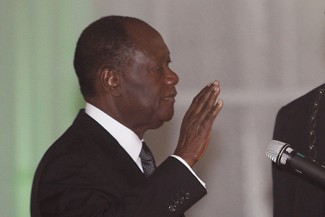
In this op-ed, ICTJ President David Tolbert argues that President Alassane Ouattara should use his second term as president to address widespread atrocities committed in Cote d'Ivoire's recent past.

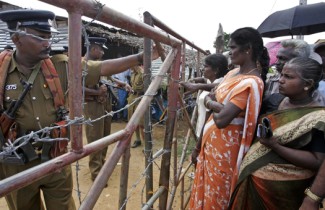
Sri Lanka may be undertaking a change of course towards accountability for atrocities committed during its 26-year civil war.

Some of the relatives’ stories start with the banging of a door at night, followed by a sudden abduction; others begin with a seemingly innocent citation to appear at a police station for a “routine procedure”. In any case, the stories always unfold in a desolate manner: as a loved one ...

On International Youth Day, ICTJ reaffirms the importance of engaging youth in efforts to reckon with the past in societies grappling with repressive and violent histories.

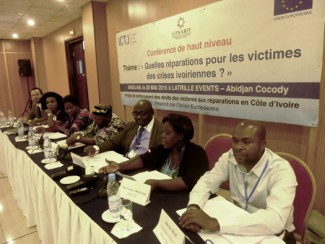
ICTJ recently facilitated consultations on reparations policy between victims of the Ivorian crisis and the National Commission for Reconciliation and Compensation for Victims in Abidjan, Côte d’Ivoire.

The new film "Don't Think I've Forgotten: Cambodia’s Lost Rock and Roll" explains the events of 1960s and 70s through the eyes of the musicians and artists who ushered in a new era of sound, only to be silenced too soon. As the world commemorates the 40th anniversary of the genocide in Cambodia, the new documentary presents the untold story of how their music managed to survive.

70-94% of the victims of enforced disappearances are men. But what happens to the women left behind? ICTJ's Amrita Kapur explains why women are uniquely impacted by the crime, and how transitional justice can help.

A major new report from ICTJ canvasses 31 countries to see how the crime of enforced disappearance affects women, as both the disappeared and the female relatives of the disappeared. It finds that across cultures, women face serious barriers to seeking relief due to discriminatory laws and practices.