

429 results

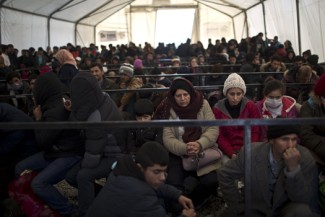
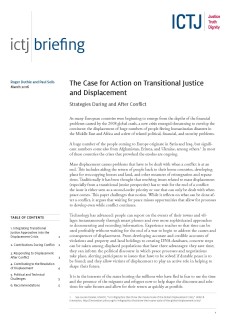
As the refugee crisis deepens, does action on transitional justice issues have to wait for peace? A new paper explores what sort of consultation and documentation work can be done now, while conflict is ongoing, to shape outcomes moving forward.

Bosnian Serb leader Radovan Karadzic was recently sentenced by the ICTY to 40 years for genocide and crimes against humanity, crimes which have decisively shaped the society in Bosnia and Herzegovina. In this essay, ICTJ’s Refik Hodzic explores what would it take for this poisonous legacy to be dismantled and makes a case for acknowledgement and reparations as matters of moral imperative, but also of political necessity.

The International Center for Transitional Justice (ICTJ) condemns in the strongest terms the Egyptian government’s crackdown against human rights activists and calls on it to halt its ongoing investigation of independent human rights organizations in relation to the legitimate exercise of their activities and to close Case No. 173 (the “NGO foreign funding” case) once and for all.

As we search for ways to halt the violence and foster lasting peace in societies grappling with a legacy of massive human rights abuse, there is arguably no more important day to reflect upon the importance of the struggle for truth and justice than today, March 24. Thus, we take a moment to mark the International Day for the Right to the Truth concerning Gross Human Rights Violations and for the Dignity of Victims.

The International Center for Transitional Justice (ICTJ) and the Barcelona International Peace Resource Center (BIPRC) are pleased to announce an Intensive Course on Transitional Justice and Peace Processes, taking place in Barcelona, Spain, June 6 - 10, 2016. It will focus on practical examples of recent or paradigmatic peace processes where the question of justice formed a significant part of the negotiating context.

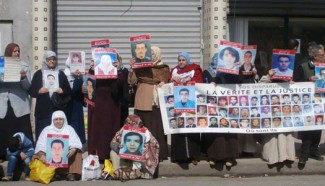
For more than two decades, some 40 women have been protesting every Wednesday against government inaction on the disappeared in front of Algeria’s official human rights commission. They stand on the sidewalk holding photos of their disappeared relatives — their children, fathers, and husbands — breaking the silence at a dangerous time in Algeria.

Earlier this month, the International Center for Transitional Justice (ICTJ) and its partners opened a two-week photo exhibit at the American University of Beirut’s Jafet Library, featuring vivid and often deeply personal photographs submitted for its “The War As I See It” youth photo contest. Students, professors, experts, and journalists packed into the library space lined with the 26 photographs in oversized frames.

ICTJ and the Human Rights and Atrocity Prevention Clinic at Benjamin N. Cardozo School of Law are pleased to announce a strategic research partnership to examine international law and practice regarding enforced disappearance and the missing.

In October 2015, ICTJ asked Lebanese young people to use their cameras to explore their understanding of the Lebanese civil war as it shapes their country’s past and present. "The War as I See It" youth photo contest was organized to raise awareness about the importance of tru...

The month of January has a particular significance in the Middle East and North Africa. It was the month when the Arab uprisings were sparked five years ago. It was also the month when the transitional justice process was inaugurated in Morocco, 12 years ago. What can be learned from Morocco’s experience?