


463 results

In a new op-ed, ICTJ Vice President Paul Seils argues that Kenya’s Truth, Justice and Reconciliation Commission (TJRC) should have been the shining light that led the way in restoring trust and confidence in office holders, institutions and government. Instead, its final report is mired in pointless controversy. Now, Kenya has a key opportunity to address allegations that the president's office interfered with the report's findings.

The International Center for Transitional Justice ICTJ welcomes the release of the Truth, Justice and Reconciliation Commission (TJRC) Report, which is the result of an official truth-seeking process undertaken by Kenya following the 2007/2008 post-election violence. The report shares the TJRC’s findings on gross violations of human rights, economic crimes, illegal acquisition of public land, marginalization of communities, and ethnic violence between 1963 and 2008.

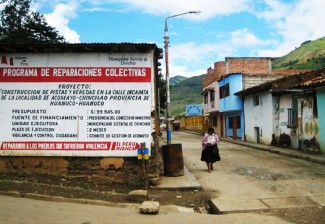
Reparations seek to recognize and address the harms suffered by victims of systematic human rights violations. ICTJ’s Reparative Justice program provides knowledge and comparative experience on reparations to victims' groups, civil society and policymakers worldwide. In this edition of the ICTJ Program Report, we look at ICTJ's work on reparations in dynamic transitional contexts such as Nepal, Colombia, Peru, DRC, and Uganda.

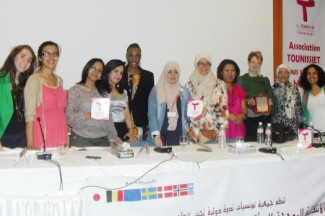
An ICTJ immersion course brought together women from Egypt, Yemen, Syria, and Libya to closely observe Tunisia’s emerging experience in transitional justice, including the ways in which issues of gender-based violence and the experiences of women are being addressed.

ICTJ released a briefing paper today examining current opportunities for prosecuting serious crimes within Kenya’s national judicial system, including crimes committed during the postelection violence of late 2007 and early 2008 (PEV), which claimed 1,113 lives and displaced an estimated 660,000 people. Titled “Prosecuting International and Other Serious Crimes in Kenya,” the paper looks at legal and institutional reforms that may be needed at the national level to effectively investigate and prosecute the worst crimes of the PEV period, including murder, serious assault, and rape.

This briefing paper focuses on the topic of prosecuting international and other serious crimes in Kenya, including crimes committed in the context of the postelection crisis of late 2007 and early 2008. In particular, it identifies and analyzes obstacles and opportunities for such pro...

Despite the overwhelming percentage of Lebanese who were affected by recent wars and political unrest, discussion of Lebanon’s past is largely absent from public spheres. A new documentary follows youth in Lebanon as they set out to find the truth.

In our work providing assistance to societies around the world, we draw continual inspiration from individuals and communities who refuse to ignore the abuses of the past, and who often face great obstacles to expose it. To honor their courage, we invite you to read a selection of perspectives on truth and dignity from those who have used their words to convey a powerful idea: truth is the foundation of justice.

This year, ICTJ's campaign for the International Day for the Right to the Truth centers around the theme, “Truth is the Foundation of Justice.” This notion, fundamental to the idea of a comprehensive approach to justice, is explored through several new releases from ICTJ.

March 21, 2013, New York, NY- The International Center for Transitional Justice (ICTJ) is launching a global awareness campaign for the International Day for the Right to the Truth, March 24, to affirm the right of victims to know the truth about human rights violations. Under the slogan, “Truth is the foundation of justice,” ICTJ’s campaign will highlight the important role that truth commissions can play in societies dealing with a legacy of violence and repression.