473 results

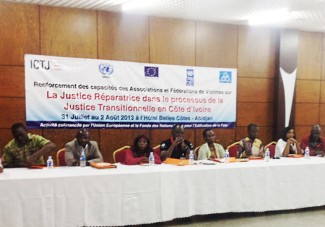
In order to create lasting reconciliation between the victims of post-election violence and the Côte d’Ivoire state, the reparations program must respond to the most serious consequences of the violence for victims through measures that address their long-lasting socioeconomic, psychosocial, and education-related effects for victims and their children. To do that, ICTJ's Cristián Correa and Didier Gbery spent more than a year discussing needs with victims groups throughout the country.

Reparations for victims of sexual and gender-based violations (SGBV) raise a series of complicated questions and implementation challenges around how to acknowledge this category of victims and deliver reparations without exposing victims to stigma and rejection. Victims must weigh the risk of...

For many young people in countries that have experienced gross human rights violations, hip hop culture has been a lifeline and a surefire way to communicate their concerns and their will to resist oppression and change reality for the better. Through its initiatives in several countri...

On October 14, The Gambia’s Truth, Reconciliation and Reparations Commission will begin public hearings with women victims who have dared break the nation’s silence around sexual violence. The hearings represent an important step toward the inclusion of women and their experiences in the Gambian truth-seeking process. But we cannot stop there.

The story of Mark and Sharon, two Kenyan youths who believed in the importance of unveiling the truth about past crimes in Kenya and participated in the TJRC process.

In a fast-changing world, ICTJ regularly reexamines and adapts its methodology to develop innovative solutions to emerging problems, advance its mission, and achieve justice for victims of human rights violations. In that spirit, ICTJ recently launched an exciting new website and newsletter design. After over a year of research, planning, surveying stakeholders, designing, and testing, we unveiled a site that better aligns with what ICTJ and transitional justice are today.

ICTJ talked to Kenyan youth leader Carine Umutoniwase to know how learning from a violent past inspires youth in countries recovering from conflict and repression to avoid past mistakes and to come up with solutions that contribute towards a more just and accountable society.

ICTJ's Virginie Ladisch explores the consequences of social stigmatization and other problems facing children born of war in Uganda, Nigeria and beyond in this new op-ed.

Sexual violence against men and boys in times of conflict or repression is alarmingly common— and takes a markedly consistent form across contexts in terms of how it affects victims and societies as a human rights violation that is taboo to talk about. It has been committed in all cul...

Sexual violence against men and boys is alarmingly common amidst conflict or repression, but these crimes are often mishandled. A new ICTJ report examines how transitional justice efforts in South Africa, Kenya, Cambodia, and beyond have responded to the needs of male victims of sexual violence. What lessons can be drawn from these approaches?