

57 results

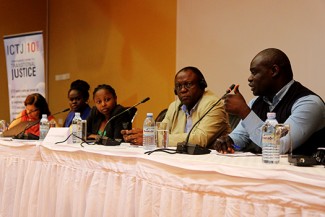
A new ICTJ report argues that in Africa's interconnected Great Lakes region, each country’s attempt to provide justice for past violations offers lessons for similar processes in others. We gathered civil society activists from across the region to discuss which strategies have worked for them, which have not, and opened up about the greatest challenges they face in securing justice.

In a major effort to promote accountability for serious crimes in Africa, ICTJ joined hundreds of human rights groups and transitional justice partners to ask the African Union to prioritize justice. Addressed to the new African Union (AU) Chairperson Dr. Nkosazana Dlamini-Zuma, the letter warns that strained relationships between the AU and the International Criminal Court (ICC) may put justice at risk.

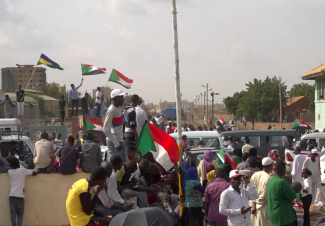
This April, Sudan marked a double anniversary: one of the 2019 revolution that toppled President Omar al Bashir’s decades-long repressive regime, the other of the 2023 outbreak of the ongoing civil war that has devastated the country. These contrasting occasions bring with them great hopes and deep pain. They also raise pressing questions: How long will Sudan have to suffer while the world’s attention seems turned the other way? How long will the voices of Sudanese who yearn for peace and justice continue to be sidelined?

JAKARTA, Nov. 15, 2011—Experts and stakeholders from Cambodia, the Philippines, Bangladesh, Indonesia, Burma, Timor-Leste, Thailand, and Nepal, along with international experts are gathering in Jakarta’s Hotel Atlet from November 15–16 to discuss the need for progress on prosecuting serious crimes in Asia.

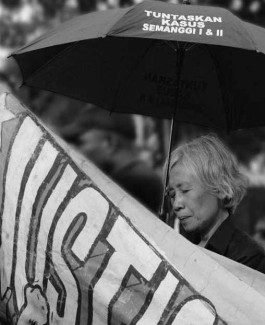
Some of the relatives’ stories start with the banging of a door at night, followed by a sudden abduction; others begin with a seemingly innocent citation to appear at a police station for a “routine procedure”. In any case, the stories always unfold in a desolate manner: as a loved one ...

ICTJ hosted a meeting, “Peace and Justice in Asia,” with a particular focus on Indonesia, Timor-Leste, and Nepal, on December 2-3, 2008. The two-day conference brought together senior experts, officials, and community leaders from three distinct areas that have suffered conflict in In...

The People’s Representative Assembly of Indonesia passed on September 7, 2004, a bill creating a “Truth and Reconciliation Commission”, which is charged with clarifying abuses committed before 2000 and determining whether to award individualized amnesties for perpetrators and reparati...

The purpose of this paper is to outline a proposal for a reparations program for Timor-Leste. Timor-Leste has experienced a number of mechanisms designed to provide justice for past wrongs. These have attempted to provide truth, criminal justice, and security sector reform. However to...

Despite considerable progress, rising tensions between and among various actors have illuminated the need to evaluate peace-building efforts from a transitional justice perspective. This report, based on research conducted by ICTJ and Acehnese civil society, aims to provide such an ev...

A joint report released by the International Center for Transitional Justice (ICTJ) and KontraS (the Commission for the Disappeared and Victims of Violence) examines the variety of state-sponsored initiatives to address mass violations of human rights in Indonesia since the fall of So...