194 results

The issuance of the first sentences by Colombia’s Special Jurisdiction for Peace marks a turning point for transitional justice in the country. These historic convictions against those most responsible for war crimes and crimes against humanity committed during the armed conflict constitute the realization of justice and express both judicial and moral condemnation.

Colombia's Special Jurisdiction for Peace (SJP) aims to achieve criminal accountability through a mixed system of restorative and retributive justice. Generally speaking, the SJP envisions large-scale restorative justice measures involving public acknowledgments of responsibility, as ...

Through its initiatives in several countries, ICTJ has learned that hip hop music can be a powerful and effective way to engage young people in transitional justice issues, such as truth, memory, and reconciliation, and encourage their participation in ongoing processes. The music, whic...

On November 28, 2023, ICTJ organized an international dialogue in Bogotá, Colombia, to share innovative strategies for advancing victims’ rights to redress for human rights abuses and for establishing more victim-centered development policies. The gathering also marked the official launch of ICTJ’s new report—Advancing Victims’ Rights and Rebuilding Just Communities Local Strategies for Achieving Reparation as a Part of Sustainable Development—which presents findings from a two-year comparative study of local efforts in Colombia, The Gambia, Tunisia, and Uganda to advance reparations.


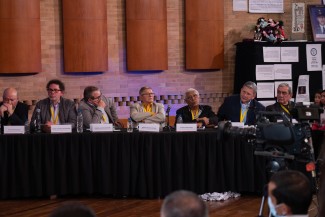
ICTJ welcomes the announcement of formal peace talks between the Government of Colombia and the National Liberation Army (ELN). This new process opens the possibility of achieving comprehensive peace in the country and entering a new phase in Colombian history.

ICTJ, in collaboration with the Center for Media Integrity of the Americas, the Cyrus R. Vance Center for International Justice, and the New York City Bar Association, recently hosted a screening of the Colombian documentary Después del Frío ("After the Cold"). Coproduced by ICTJ and Colombian journalist María Jimena Duzán, with the support of the Embassies of Sweden and Norway in Colombia, the film paints an intimate portrait of a nation seeking healing and transformation, where the scars of the past give way to hope.

Since time immemorial, justice for a crime has generally meant punishment of the wrongdoer. Even today, some members of society, including victims and lawmakers, still believe that justice is not served unless the guilty party receives a stern and punitive sentence, such a long prison t...

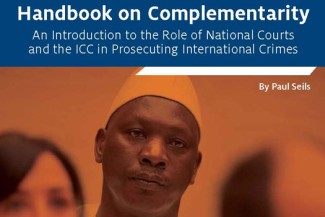
A new handbook written by ICTJ vice president Paul Seils explores the relationship between the ICC and national courts.

ICTJ welcomes the announcement the government of Colombia and the FARC-EP have agreed on a series of modifications to the peace accords, after the original version was narrowly rejected in the October plebiscite vote.

ICTJ participated in the launch of a new report on the relationship between transitional justice and development, launched by the Swedish International Development Agency (Sida).