


194 results

Indigenous rights are increasingly being addressed through different transitional justice measures, and ICTJ is actively involved in the discourse on how truth commissions and other transitional justice mechanisms can help the struggle for the rights of indigenous people.

To mark International Women’s Day, we invite you to read about four countries at the top of our gender justice priorities in the coming year, each with its own history, context, and complex sets of challenges.

In Colombia, the shifting boundaries between drug trafficking and political crime and the tension between security and human rights pose particular challenges for those seeking accountability for past abuses and respect for human rights.

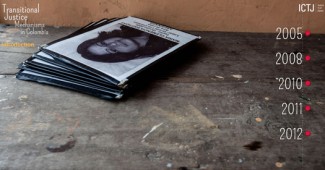
Next week, the Colombian courts will issue the first partial verdict in the Justice and Peace case against the paramilitary leader Hebert Veloza García, alias “HH,” one of the most significant cases of the Justice and Peace process. Ahead of the HH partial verdict on October 30th, ICTJ is launching a comprehensive timeline on transitional justice measures implemented in Colombia since 2005 that recognize victims' rights to truth, justice, reparations, and the guarantee of non-recurrence.

The recent re-election of Colombia’s president, Juan Manuel Santos, brings hope to a country seeking to end a half-century of conflict. But, as with so many peace processes, finding a balance between creating a stable accord and acknowledging the terrible injustices that occurred during the conflict can be difficult to achieve.

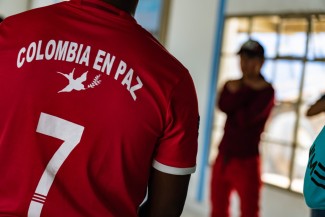
The ICTJ office in Colombia joined forces with the Movement of Latin American Expressions of Hip Hop (MELAH) and the online cultural outlet Revista Cartel Urbano to host the hybrid virtual and live International Hip Hop Encounter in Bogotá, Colombia.

Perspectives of Colombians particularly affected by the country's conflict – women, young people, and indigenous peoples – who are demanding truth.

An internal armed conflict involving the government, leftist guerrillas, and a variety of paramilitary groups and criminal bands has endured in Colombia for the last 60 years, generating massive levels of displacement. A comprehensive truth commission that investigates major human rig...

By this summer, dozens of paramilitaries and guerrillas in Colombia's Justice and Peace process will have already spent eight years in prison. In accordance with the law, those who fulfill their obligations to contribute to the truth and provide reparation to victims should be released after serving eight years. In this op-ed, ICTJ's Maria Camila Moreno analyzes the valuable lessons learned through this process.

The struggle against impunity remains as important –and precarious –as ever as we celebrate International Justice Day on July 17. ICTJ marks the occasion with a look at complementarity, a concept critical to understanding the role that the ICC and national courts play in this struggle.