1519 results

During the 1970s, political violence in Argentina resulted in massive violations of human rights including thousands of deaths, prolonged and arbitrary arrests, disappearances, unfair trials, pervasive torture, in addition to cruel, inhuman, and degrading treatment. Since the restorat...

This case study offers an overview of some of the major issues and recent developments in transitional justice in Croatia. While the main focus is on war crimes prosecutions before the International Criminal Tribunal for the former Yugoslavia and Croatian courts, it also examines trut...

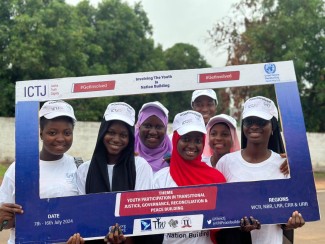
Almost eight years since The Gambia's former President Yahya Jammeh left power, the country is still seeking justice for the human rights abuses committed during his 22-year dictatorship. In May 2023, the Ministry of Justice released a plan to implement the recommendations of the country's Truth, Reconciliation and Reparations Commission. While the plan promises to deliver justice and repair harms, for it to have its intended impact, it requires broad public participation in the process, especially that of young people. With that in mind, ICTJ has partnered with the UN Peacebuilding Fund on a project to encourage Gambian youth to take a leading role in this process and the country's future.

This report examines community expectations and experiences of Timor-Leste’s unique transition from occupation to independence. It documents the results of focus group discussions on an array topcis including violence and conflict, truth recovery, justice, accountability, reconciliat...

ICTJ and the Center for Human Rights and Global Justice at NYU School of Law are pleased to announce that that Darren Walker, President of the Ford Foundation, and Sherrilyn Ifill, President and Director-Counsel of the NAACP Legal Defense Fund, will join ICTJ President David Tolbert in conversation for the ninth Emilio Mignone Lecture on Transitional Justice.

Little has been written about the relationship between transitional justice measures and DDR programs with respect to child ex-combatants. We argue that the primary avenue through which transitional justice measures may positively affect the reintegration of former child combatants is...

Lebanon has long been afflicted by a combination of political deadlock and a lack of accountability that has resulted in ongoing human rights violations and overall systemic rot. Comprehensive reforms, along with an inclusive truth-seeking process, broad public dialogue, and other way...

The 2006 crisis in Timor-Leste saw close to 15 percent of the population displaced from their homes, threatening to sink the country into protracted instability and violence. Remarkably, five years later the country was back on track, with the internal displacement issue largely resol...

Argentina’s trials for crimes committed during the dictatorship of military juntas are widely seen as a successful national effort to seek accountability for past abuses. And while victims’ demands for justice continue to remain high, the judiciary is facing challenges to ensure the cases are dealt with expeditiously and fairly. In a interview for ICTJ's Spanish podcast series "Lessons from Latin America," Mirna Goransky, Assistant General Prosecutor for the Attorney General’s Office shares her perspectives on human rights trials in Argentina.

The International Center for Transitional Justice strongly welcomes the decision of the UK High Court ordering the British government to pay damages to a group of Kenyans who were imprisoned and tortured by colonial authorities following the Mau Mau Rebellion of the 1950s.

In countries emerging from violent conflict and repression around the world, prosecutors are facing significant challenges and pressures when seeking to investigate and prosecute serious crimes, such as torture, extrajudicial killings, and enforced disappearance. To reflect on these challenges, ICTJ together with the International Nuremberg Principles Academy, and with support from the governments of Australia and Sweden, convened a side event on December 6, 2019, during the 18th Assembly of State Parties of the International Criminal Court.

Both of the books reviewed here provide deep analysis regarding the challenges of repairing historical mass crimes and past harmful policies, aswell as the limitations and difficulties of such endeavors.

The Democratic Republic of Congo (DRC or Congo) presents a critical test for the International Criminal Court (ICC). All of the accused in current ICC trials are from DRC. The Court plays a vital role in DRC regarding complementarity, peace, justice, victims, and affected communities....

Amicus curiae on petition for a writ of certiorari, to the United States Court of Appeals for the second circuit.

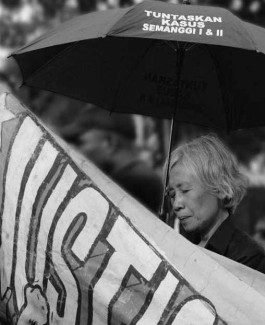
A joint report released by the International Center for Transitional Justice (ICTJ) and KontraS (the Commission for the Disappeared and Victims of Violence) examines the variety of state-sponsored initiatives to address mass violations of human rights in Indonesia since the fall of So...

EXECUTIVE SUMMARY: A joint report released by the International Center for Transitional Justice (ICTJ) and KontraS (the Commission for the Disappeared and Victims of Violence) examines the variety of state-sponsored initiatives to address mass violations of human rights in Indonesia s...

This report provides parameters for the creation of a reparations program in Peru. The program must be included in the process of raising a new national awareness in Peru regarding past abuses and building a legal-political framework more responsive to human rights. To ensure sustaina...

In this op-ed, ICTJ Vice President Paul Seils analyzes the criminal justice agreement announced by the Government of Colombia and the FARC and discusses what aspects of the deal need clarification to ensure that it is capable of delivering the kind of truth and justice that victims of Colombia's armed conflict deserve.

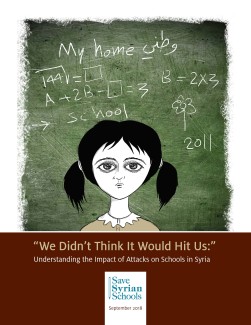
A new report on attacks on schools in Syria harnesses documentation to call attention to atrocities and advance storytelling, truth seeking, acknowledgment. It is the product of Save Syrian Schools, a collaborative project led by 10 Syrian civil society organizations and the ICTJ that demands an end to the killing of Syrian children and justice for the bombing of schools.

This report examines attacks on schools in Syria from multiple angles: from the legal implications of such attacks to the everyday impact on students, teachers, families, and society at large. It is the product of Save Syrian Schools, a collaborative project led by...

Difficult Peace, Limited Justice: Ten Years of Peacemaking in the DRC reviews the efforts to address justice during ten years of varied peace negotiations in the Democratic Republic of Congo. A close look the dynamics of peace talks and the resulting accords -- including those of Sun ...

This report arises out of a perceived opening or window of opportunity for transitional justice intervention around the specific gross human rights violation of enforced disappearances and abductions in Nepal. This issue connects powerfully to several dominant concerns within the tran...

This report offers analysis of the current situation regarding the judicial handling of cases related to the post-election violence in Cote d’Ivoire. It looks at existing legal and political challenges within the domestic proceedings and suggests possible solutions.

DDR programs are seldom analyzed to consider justice-related aims; and transitional justice mechanisms rarely articulate strategies for coordinating with DDR. Disarming the Past: Transitional Justice and Ex-combatantsexamines how these two types of initiatives have connected—or f...

This report examines the contribution of transitional justice to prevention in the Philippines, as well as the limits of this contribution due to the failure to comprehensively address and learn from the past and undertake structural changes. While reparations, truth telling, and inst...