

1519 results

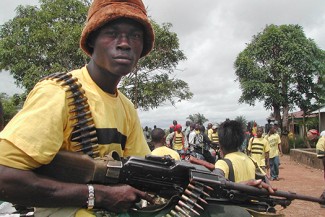
In the Netherlands, a court sentenced an arms dealer to 19 years in prison for his role in war crimes in Liberia. What does his case tell us about pursuing justice for economic crimes in Liberia and beyond?

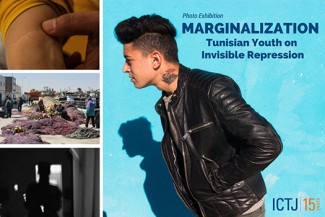
Ongoing economic and social inequality, a legacy of the dictatorship, affects Tunisians across generations, but has particularly pronounced impacts on young people. ICTJ worked with four young photographers to confront the consequences of marginalization and explore its impacts on Tunis...

This is the third time that the Tunisian government, supported by several Members of Parliament, has put debate of the National Reconciliation Law on the political agenda. Rearranged in form but with the same substantial faults, this law has mobilized the opposition — for the third time — of approximately 20 civil society organizations that met yesterday and plan to soon hold a press conference.

In Africa's Great Lakes region, countries face common challenges like bad governance, inequitable distribution of natural resources, and ethnic divisions. As nations like Burundi, Central African Republic and South Sudan work towards peacebuilding and accountability, they should learn from what has worked and what has not in neighboring countries, writes Sarah Kihika Kasande, ICTJ's Head of Office in Uganda.

The impact of Tunisia's transitional justice process is rooted in its ability to give voice to diverse segments of the population, including historically marginalized communities. A workshop hosted by ICTJ brought generations of women together to explore truth-telling techniques and create space for all voices.

Money alone cannot compensate sexual violence committed on a massive scale, particularly when such crimes are accompanied by other forms of violations affecting entire communities. ICTJ's Cristián Correa examines how rehabilitation, education, and acknowledgement can bring victims closer to full restitution for their suffering.

A new briefing paper from the International Center for Transitional Justice provides guidance for national courts issuing decisions on redress of human rights violations involving sexual violence. It encourages judges, advocates and prosecutors to consider the full range of possible forms of redress when ordering reparations for victims, to make use of relevant national and international decisions in interpreting domestic laws, and to pay particular attention to how sexual violence may affect different victims.

For decades, successive Myanmar political and military leaders, including Aung San Suu Kyi’s, have flatly denied what millions of their citizens know: that the military has committed and continues to commit human rights violations. A new UN inquiry into those crimes is provides a moment of truth for Suu Kyi's commitment to justice, writes ICTJ's Aileen Thomson.

Zambia should reaffirm its membership in the International Criminal Court to best advance justice for victims of atrocities, a group of African organizations and international nongovernmental organizations with a presence in Africa said today.

Defining court-ordered reparations for victims of sexual violence committed during armed conflict, political violence, or state repression is not an easy task. The challenges only increase when there are few domestic precedents for defining such reparations based on international huma...

In today’s United States, civic trust that has been systematically eroded among many communities of color. There is little basis, either historically or in the current political atmosphere, for African Americans and other minorities to have this essential trust in government institutions, particularly in the police. To build that relationship, there must first be a reckoning, writes ICTJ President David Tolbert.

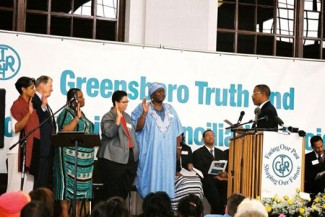
To mark 15 years of ICTJ, we asked staff past and present for the memories that stand out from their work. Former ICTJ consultant and Executive Director of the Truth and Reconciliation Commission in Greensboro, North Carolina Jill Williams reflects on her efforts to bridge a cultural gap in the pursuit of shared values.

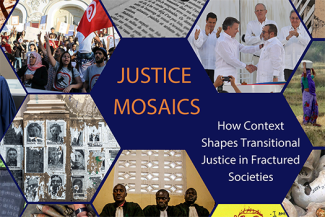
A new ICTJ report argues that in Africa's interconnected Great Lakes region, each country’s attempt to provide justice for past violations offers lessons for similar processes in others. We gathered civil society activists from across the region to discuss which strategies have worked for them, which have not, and opened up about the greatest challenges they face in securing justice.

As Burundi and South Sudan teeter on the verge of renewed conflict, with warnings of possible genocides, a new report from ICTJ on the African Great Lakes region asserts that there are lessons to be learned from neighboring countries that may be relevant in preventing new conflicts. The report calls for a clear understanding of victims’ needs and demands, a thorough political analysis and identifying realistic opportunities for acknowledgment and accountability, among other measures.

In many countries of the African Great Lakes region, state-led approaches to transitional justice have been created by wide-ranging agreements or policies that have been later forgotten or only partially implemented. Even when implemented, they are often subject to years of delay and/...

The taboo around sexual violence against men and boys can leave victims in the shadows, write ICTJ's Kelli Muddell and Sibley Hawkins. Without acknowledgment of these crimes, efforts to address injustices of the past will be hard-pressed to develop inclusive and effective responses.

On the International Day for the Right to Truth we spotlight one of the most powerful ways truth commissions can reassert victims' dignity: public hearings. These open events can have a potentially cathartic power for victims and their families, but also the public at large by generating solidarity and empathy for the suffering of others in societies deeply polarized and traumatized by atrocities and denial.

In Tunisia, the Truth and Dignity Commission's public hearings have fundamentally altered the dialogue around the past in Tunisia. To mark the International Day for the Right to Truth ICTJ Director of Communications Refik Hodzic sat down with two women whose work has been critical to the success of the commission – ICTJ Salwa El Gantri and TDC Commissioner Ibtihel Abdellatif – to discuss what they have taken away from public hearings so far.

In Tunisia, public hearings have fundamentally changed public dialogue about the past. The Truth and Dignity Commission will hold special session scheduled to coincide with the International Day for the Right to the Truth on March 24th. Watch live here:

The right to the truth carries special resonance in Kenya, and so on March 24th Kenyan state agencies, survivors, civil society organizations, and international partners will join together in Nairobi to observe the International Day for the Right to the Truth. It provides an opportunity not just for remembrance, but also for greater dialogue between the government and victims about the implementation of reparations programs and of the findings presented in the Truth, Justice and Reconciliation Commission's final report.

Education, as a critically important institution that is widely considered to be both formative and transformative, is something that transitional justice cannot afford to overlook. Transitional justice in its early years did not directly engage with education, but today this has chan...

This paper explores the power of a transitional justice approach to education reconstruction in post-conflict settings. Its central question is how the aims of transitional justice can guide educational reform processes after conflict or periods of massive human rights violations, wit...

As ICTJ looks back on its 15 years of work, join us in celebrating our allies across the globe who struggle for human rights, against impunity. To honor their efforts in the trenches of this struggle, we will bring you their stories in the weeks and months to come. This is the story of Mark Thompson, CEO of Relatives for Justice, a group struggling for truth and justice in Northern Ireland.

Tunisia's Truth and Dignity Commission continues its public hearings, focusing on violations of digital freedom.

At 3 pm, Eastern Time, Tunisia's Truth and Dignity Commission is scheduled to resume its public hearings with a session focusing on violations against women. Watch the livesteam below and follow us on twitter at @theICTJ for live coverage.