

1519 results

Some habits die hard. This is especially true of ways of thinking. Despite significant changes in national and international law and practice in the last thirty years—the period that corresponds with the emergence of transitional justice as a field—the recent upheaval in the Middle East and Northern Africa region has provoked proposals that hearken back to a period that we may have thought long gone.

The allegations of war crimes and crimes against humanity committed in the final phases of the conflict in Sri Lanka, made in the Report of the Secretary-General’s Panel of Experts on Accountability in Sri Lanka released on April 25, must be thoroughly investigated. This is the first comprehensive UN report examining the events in the Vanni region between January and May of 2009 and it alleges that “tens of thousands of civilians” were killed. The Government of Sri Lanka, but also the relevant international bodies, cannot claim credibility if these findings are ignored.

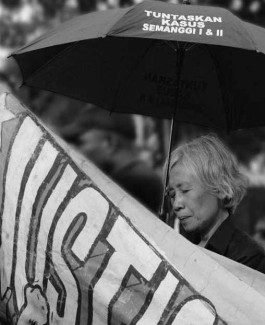
EXECUTIVE SUMMARY: A joint report released by the International Center for Transitional Justice (ICTJ) and KontraS (the Commission for the Disappeared and Victims of Violence) examines the variety of state-sponsored initiatives to address mass violations of human rights in Indonesia s...

A joint report released by the International Center for Transitional Justice (ICTJ) and KontraS (the Commission for the Disappeared and Victims of Violence) examines the variety of state-sponsored initiatives to address mass violations of human rights in Indonesia since the fall of So...

Progress Is Unmistakable. An interview with Juan E. Méndez, President of ICTJ.

In September 1985, ninemembers of Argentina’smilitary junta, whose successive regimes covered the period in Argentine history known as the “dirty war,” walked into a courtroom in downtown Buenos Aires.

More Than Just the Court. An interview with Marieke Wierda, director of ICTJ’s Prosecutions Program.

Making Connections. An interview with Pablo de Greiff, ICTJ Research Unit Director.

Building for the Future. An interview with Hanny Megally, ICTJ Middle East and North Africa Program Director.

A New Paradigm. An interview with Louis Bickford, ICTJ Memory, Museums and Monuments Program.

A Tireless Push for Justice. An interview with Javier Ciurlizza, Deputy Director of ICTJ’s Americas Program.

Truth Is the First Step. An interview with José Zalaquett, ICTJ Board Member.

At the Forefront of the Struggle. An interview with Suliman Baldo, ICTJ Africa Program Director.

Lessons to Be Learned. An interview with Howard Varney, director of ICTJ’s Truth-Seeking Program.

History As It Happened. An interview with Ruben Carranza, senior associate in ICTJ’s Reparations Program.

Th e Tip of the Iceberg. An interview with Lisa Magarrell, director of ICTJ’s Reparations Program and U.S. Accountability Project.

This is a compilation of cases from the Criminal Chamber of the Supreme Court of Colombia.

A New ICTJ President Thinks About the Future. An interview with David Tolbert, President of ICTJ.

Kenya’s Struggle toward Accountability and Justice. An interview with Njonjo Mue, head of ICTJ’s Nairobi office, and Comfort Ero, deputy director of ICTJ’s Africa Program.

Remedying Human Rights Violations. An interview with Ana Cutter Patel, deputy director, ICTJ International Policymakers Program.

Looking Back to Move Forward. An interview with Daniela Gavshon, Head of ICTJ's Honiara office, about the Solomon Islands Truth and Reconciliation Commission.

Background on the challenges in addressing legacies of past violence in sub-Saharan African countries such as Uganda, Ethiopia and Eritrea. The fact sheet gives an overview of the situation in the region and ICTJ's approaches in promoting transitional justice in individual countries. ...

In August 2006 the Security Council created the UN Serious Crimes Investigation Team, as an extension of the previous investigation under the UN Integrated Mission Timor-Leste.

Justice and peace have been the highest aspirations of modern societies. Legislative bodies have enacted laws such as Law 975 of 2005, which ordered the State to provide instruments to resolve armed conflicts without neglecting fundamental social interests of truth, justice, and repar...

In many societies, histories of exclusion, racism, and nationalist violence often create divisions so deep that finding a way to deal with the atrocities of the past seems nearly impossible. These societies face difficult practical questions about how to devise new state and civil soc...