1519 results

For the last 50 years Cypriots have been living amid various forms of conflict between political leaders, communities and armed forces. Divisive re-tellings of key moments in these conflicts continue to be important to the politics of all communities on the island.

The People’s Representative Assembly of Indonesia passed on September 7, 2004, a bill creating a “Truth and Reconciliation Commission”, which is charged with clarifying abuses committed before 2000 and determining whether to award individualized amnesties for perpetrators and reparati...

ICTJ provides constructive comments on the draft Internal Rules for the Extraordinary Chambers in the Courts of Cambodia (ECCC). While the draft Internal Rules provide greater procedural clarity for the ECCC proceedings, ICTJ lists several concerns in five areas that must be focused o...

The South African Coalition for Transitional Justice (SACTJ) submits the following comments regarding the May 11, 2010 General Notice 282 published in the Government Gazette. The Coalition objects to the Notice 282 regulations on procedural, constitutional, and international law groun...

This report aims to help practitioners in the transitional justice field to understand the experience of establishing and operating hybrid courts and to address some common assumptions about these entities. To do so, it looks at hybrid or mixed courts in practice, drawing on experienc...

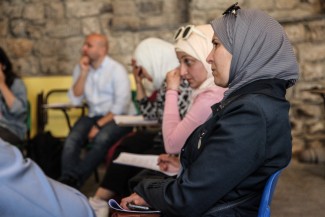
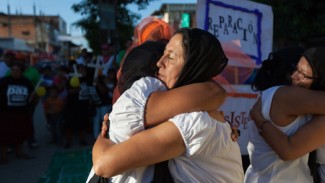
At the end of April in Syria, dozens of local residents in several cities and towns sat down together for the first time to finally speak about their experiences during the 14-year conflict that tore society apart and resulted in countless human rights violations. These community dialogues, organized by ICTJ in partnership with the Bridges of Truth project, provided a safe space for participants to share their stories and hardships, discuss their needs, and express their hopes for justice and reconciliation.

ICTJ, with the sponsorship of the United Natinos Rule of law Unit and the support of the Secretariat of the Assembly of States Parties (ASP) to the International Criminal Court (ICC), hosted a retreate entitlted "Complementarity After Kampala: The Way Forward" on October 28-29, 2010, ...

Reparations and development are generally conceptualized and approached independently, but for survivors and victims the demand for both often arises simultaneously. In practice, reparations and development are linked in specific ways. This paper analyzes these links in the context of...

The purpose of this paper is to outline a proposal for a reparations program for Timor-Leste. Timor-Leste has experienced a number of mechanisms designed to provide justice for past wrongs. These have attempted to provide truth, criminal justice, and security sector reform. However to...

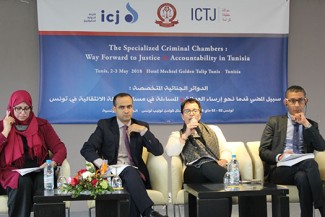
TUNIS—ICTJ hosted a conference on May 2 and 3 to address the current challenges facing Tunisia’s Specialized Criminal Chambers (SCC) as it proceeds to adjudicate cases of serious human rights violations committed under the former regime. The 90 guests who attended included members of Tunisia’s Truth...

Background on the challenges in addressing legacies of past violence in sub-Saharan African countries such as Uganda, Ethiopia and Eritrea. The fact sheet gives an overview of the situation in the region and ICTJ's approaches in promoting transitional justice in individual countries. ...

Background on the challenges in addressing legacies of past violence in sub-Saharan African countries such as Uganda, Ethiopia and Eritrea. The fact sheet gives an overview of the situation in the region and ICTJ's approaches in promoting transitional justice in individual countries. ...

This briefing paper summarizes the findings of consultations undertaken by ICTJ with women’s groups in Gulu, Lira, and Soroti on confronting impunity and engendering transitional justice processes in northern Uganda. Its purpose is to help incorporate women’s needs and justice demands...

Background on conflict in the Democratic Republic of Congo (DRC) and the Central African Republic (CAR) in the context of Jean-Pierre Bemba’s trial at the International Criminal Court (ICC). The ICC is preparing to prosecute Bemba of the DRC for alleged rapes, torture and murders that...

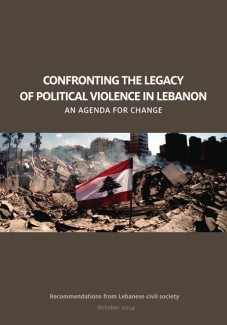
This document presents wide-ranging recommendations for political and social reforms in Lebanon developed by a consortium of Lebanese civil society actors, as part of an ICTJ project. Directed at Lebanese authorities, the recommendations address the well-documented and widespread viol...

Lebanon should take firm steps to provide redress to victims of past conflicts and help prevent future violence, ICTJ and Lebanese rights groups said today at a roundtable discussion in Beirut. Lebanese authorities have mostly failed in their responsibility to end ongoing violations and ensure justice and truth for victims of the 1975-1990 war and successive conflicts.

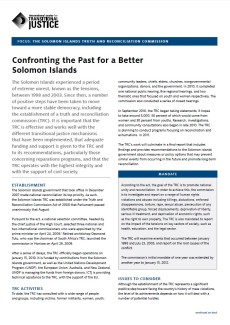
FOCUS: The Solomon Islands Truth and Reconciliation Commission. The Solomon Islands experienced a period of extreme unrest, known as the tensions, between 1998 and 2003. Since then, a number of positive steps have been taken to move toward a more stable democracy, including the establ...

National healing and reconciliation in Uganda requires a multilayered truth-telling process comprised of community and national processes that are mutually reinforcing and should not be mutually exclusive, as proposed by the JLOS report. A national truth-telling body should address is...

Despite considerable progress, rising tensions between and among various actors have illuminated the need to evaluate peace-building efforts from a transitional justice perspective. This report, based on research conducted by ICTJ and Acehnese civil society, aims to provide such an ev...

This volume examines the effects, risks, and potential of extending the field of transitional justice to cases that do not present a key moment of political transition to peace or democracy and instead are defined by political continuity and ongoing conflict. It begins with analyses o...

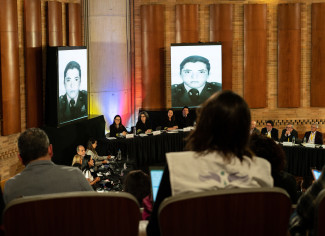
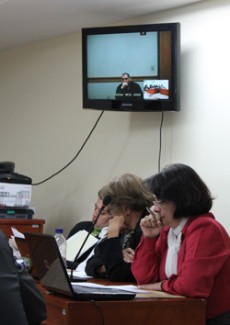
The Justice and Peace Chamber ruling in the hearing to verify the legality of the charges against Hebert Veloza Garcia contained information on the context in which these occurred. According to the Tribunal, it thus seeks to “contribute elements that underpin the analysis of the modus operandi, the patterns, if any, and the dynamics in which the criminal structure under the command of Hebert Veloza Garcia, alias “H.H.” was organized, as well as to “establish the judicial truth with respect to the criminal actions of the paramilitary groups in different regions of the country.”

This manual was developed within the Framework Agreement for Cooperation between the International Center for Transitional Justice (ICTJ) and the Attorney General's Office in Colombia. This agreement was signed to provide technical assistance to the National Analysis and Context Unit ...

Continuing political repression, cronyism, and ongoing conflicts are disrupting attempts to put Myanmar on a linear path to democracy, peace, and development, says a new report from the ICTJ. According to the report, titled “Navigating Paths to Justice in Myanmar’s Transition,” dealing with current and historical abuses is essential to achieving genuine progress on peacebuilding and economic development in the country.

Transitional justice has for the most part not prioritized issues related to displaced persons. Transitional justice measures do, however, have a bearing on displaced persons’ interests and on efforts to resolve displacement, in particular with regard to durable solutions, which inclu...

This paper examines the benefits of introducing justice-related considerations into disarmament, demobilization and reintegration (DDR) programs, an idea that has only recently been considered. Drawing links between DDR and reparations programs – the former a peace and security measur...