
This interview first appeared in the Colombian outlet El Espectador on July 13, 2026.
The first rulings of the Special Jurisdiction for Peace (JEP) are now final, but the biggest challenge is just beginning: implementing them. María Camila Moreno, head of ICTJ’s office in Colombia, explains the state's obligations, the room for maneuver the new government will have, and why the future of restorative justice will be crucial for victims of the conflict.
El Espectador (EE): We now have these first two final rulings, which not only signify the beginning of their implementation and the definition of their legal status, but also represent a turning point for transitional justice in Colombia. Furthermore, these decisions will serve as a guide for future JEP rulings, one of which we will likely learn about this month. Why, in your opinion, are they so important?
Moreno: First, the appeal rulings fully confirm the decisions made at the first instance. This means that both the convictions and the judicial truth established during the process—the truth about the events, those responsible, the victims, and the gravity of the crimes committed—are now final. They also reaffirm that, in both cases, the most serious crimes recognized by international law were committed: war crimes and crimes against humanity. This conclusion is not only of enormous value to the victims, but it also demonstrates that Colombia is fulfilling its international obligation to investigate, prosecute, and punish this type of conduct, precisely that which falls under the jurisdiction of the International Criminal Court. There is another element that I consider historic.
EE: What is it?
Moreno: This is the first time that convictions for crimes against humanity have been upheld in Colombia. In previous processes, such as the Justice and Peace process, judges had indicated that certain acts could constitute this type of crime, but the Colombian Penal Code does not expressly define them. Only the legal framework of the Special Jurisdiction for Peace [JEP] allows for final judgments under this classification. Furthermore, these decisions establish criteria that will guide all future judgments. The Appeals Chamber reviewed the entire procedure and appeals process and introduced adjustments to how future cases should be handled. This review establishes much clearer rules and will likely allow new rulings to proceed more quickly.
EE: One of the most striking aspects was the exclusion of certain crimes. The crime of slavery was omitted from the ruling against the FARC, and torture and persecution were excluded from the ruling against the La Popa Battalion. How can this be explained as not meaning that the JEP is denying that these events occurred?
Moreno: It is important to clarify that the decision does not question the facts. What the Appeals Chamber found was a strictly procedural issue. These crimes should have been included during the proceedings before the Chamber for Acknowledgment of Responsibility, because that is where the defendants accept their responsibility for each of the imputed acts. However, they were included later, after that phase had already concluded. The Appeals Chamber concluded that the Chamber for Acknowledgment of Responsibility no longer had jurisdiction to do so at that procedural stage and, therefore, decided to exclude those legal classifications. This does not mean that the conduct disappears from the judgments.
EE: Could you give us an example?
Moreno: The facts remain fully recognized and are part of the factual context established during the process. What changes is the legal classification. For example, in the case of torture, the decision explains that these actions continue to be encompassed within other already recognized categories, such as cruel, inhuman, or degrading treatment. In other words, the Appeals Chamber is not saying that these acts never occurred; it simply concluded that they could not be incorporated as separate crimes at that stage of the proceedings because the law establishes a specific procedural sequence. In reality, these decisions also serve another purpose: They clarify the rules that future rulings must follow to prevent similar disputes from arising again. This strengthens legal certainty for victims, defendants, and the jurisdiction itself.
EE: In other words, besides definitively closing these two cases, the Appeals Chamber ended up setting a precedent for everything that follows.
Moreno: That is perhaps one of the most important effects of these decisions. They not only consolidate the judicial truth and the first convictions of the JEP, but also establish procedural parameters that will serve as a guide for future rulings.
EE: Let’s turn to the political landscape. A new government will take office in a few days, and the president-elect, Abelardo de la Espriella, has expressed his opposition to the JEP. How do you see this scenario, especially since the implementation of these initial rulings will depend, to a large extent, on the support of the executive branch?
Moreno: I am cautiously optimistic. The recent statements by the designated Minister of Justice, Iván Cancino, seem like a good sign. He has acknowledged that there are concerns about the functioning of the JEP, but he has also suggested that the way to address them should be through institutional dialogue with the jurisdiction. I believe that is the right approach. The JEP is entering a completely different phase. Toward the end of this year, the investigation phase will conclude, and the trial phase will begin for the macro-cases that remain open. This implies different needs, different priorities, and even a different allocation of resources. Therefore, it is reasonable for the government and the jurisdiction to have a conversation. The important thing is that this dialogue fully respects judicial independence and the powers of each institution.
EE: Of course, but during the presidential campaign, the message we heard was that the next administration would indeed seek to eliminate the JEP…
Moreno: It would not be advisable for the executive branch to try to impose decisions that would affect the fulfillment of the JEP’s constitutional mandate. What is desirable is a dialogue between public authorities under the principle of harmonious collaboration established in the constitution. Ultimately, both share a common goal: for Colombia to fulfill its obligation to investigate, prosecute, and punish the most serious crimes and for victims to see their rights to truth, justice, reparation, and guarantees of non-repetition upheld. We must not lose sight of the fact that this remains a justice system designed to contribute to peace and reconciliation.
EE: One of the main challenges for this new phase will be the budget. The Comptroller General's Office has estimated that implementing the first sanctions could cost up to COP 500 billion, while the Agency for Reintegration maintains that this figure cannot yet be precisely determined. How can this challenge be addressed in such a complex fiscal context?
Moreno: The appeals court rulings provide a very important element in answering this question. Unlike the initial rulings, there are now concrete projects, timelines, compliance indicators, and monitoring mechanisms for the sanctions. In the case of the FARC secretariat, for example, the Appeals Chamber incorporated several proposals made by the victims themselves and defined parameters to evaluate their implementation. This allows for a much more precise calculation of the resources needed over the next eight years. But there is an even more important aspect.
EE: What is it?
Moreno: The effective implementation of the sanctions is not solely the responsibility of the Special Jurisdiction for Peace. It is an obligation of the Colombian state. When bodies such as the International Criminal Court or the Inter-American Court of Human Rights evaluate compliance with these obligations, they do not examine only the work of the jurisdiction. They analyze the actions of the state as a whole. Therefore, this debate cannot be reduced to whether the new government sympathizes with the JEP or the Peace Agreement. Colombia made very clear international commitments regarding the investigation, prosecution, and punishment of the most serious crimes. Complying with the initial sentences is an obligation of the state, not of the current government.
Let us remember that when the Office of the Prosecutor of the International Criminal Court closed its preliminary examination of Colombia, it did so because the state committed to developing these justice mechanisms. That commitment continues to be monitored internationally. Naturally, there is an enormous budgetary challenge, and the country is experiencing a difficult fiscal situation. Precisely because these are international obligations, the state must make the necessary efforts to ensure that these sanctions can be enforced. Furthermore, these initial sentences will have a maximum duration of eight years. We are not talking about resources for a few months, but about commitments that must be sustained over two administrations.
EE: This implies long-term budgetary planning.
Moreno: Exactly. And this planning should be one of the first topics of discussion between the new government and the Special Jurisdiction for Peace. Because it is one thing to discuss institutional efficiency, which can always be improved, and quite another to jeopardize compliance with the obligations that the Colombian state assumed toward the victims and the international community.
EE: If a budget cut were to eventually occur that prevented the JEP from fulfilling these functions, could this be interpreted as affecting its judicial independence?
Moreno: I sincerely hope we never reach that point. I trust that the new Minister of Justice is well aware of Colombia's international obligations and the importance of the principle of separation of powers. Judicial independence is one of the pillars of the rule of law. Any decision that prevents the judiciary from fully exercising its functions could be interpreted as an infringement of that independence. Therefore, I believe the path forward must continue to be institutional dialogue and the search for joint solutions, always within the constitutional framework.
EE: During the presidential campaign, the debate about the cost of the Special Jurisdiction for Peace resurfaced. Even Humberto de la Calle, one of the architects of the Peace Agreement, has stated that it is a very expensive jurisdiction. How do you analyze this discussion?
Moreno: It is a legitimate discussion, but it is often framed too simplistically. If one looks only at the number of rulings and compares it to the JEP's budget, one might conclude that the cost-benefit ratio is unfavorable. This interpretation is very effective in public debate, but it does not reflect the true scope of the work the jurisdiction has carried out. The JEP does not investigate individual cases. It is reconstructing phenomena of mass violence involving thousands of victims, thousands of events, and hundreds of perpetrators. This is precisely the type of situation for which extraordinary mechanisms of transitional justice exist. We are not talking about an ordinary criminal process, but rather the judicial reconstruction of decades of armed conflict.
EE: Of course, and that's why it wouldn't be correct to compare the JEP's budget with that of other courts...
Moreno: Exactly. The nature of the cases, the volume of information, and the participation of the victims make it a completely different task. Now, the jurisdiction is entering a new stage. After closing the investigative phase, it is reasonable to think that its needs will change and that some of the resources allocated to that work may be redistributed. This discussion must take place, but based on technical studies and not on perceptions or slogans.
EE: Ultimately, the focus of the Peace Agreement and the JEP remains the victims. If, due to a lack of resources, the sanctions could not be carried out, what would be the outcome of all this institutional effort?
Moreno: That is probably one of the most important dilemmas of any transitional justice process. Ideally, at the end of this process, victims should feel that the state responded adequately and that their rights were truly guaranteed. But we also cannot reduce justice solely to the moment a sentence is handed down. Convictions are fundamental because they represent legal rebuke for the most serious human rights violations. However, a very important part of justice occurs during the process.
EE: Like the acknowledgment hearings?
Moreno: The JEP has created unprecedented spaces in Colombia where those responsible publicly acknowledge their responsibility to the victims. There, not only is there legal recognition, but something profoundly human also takes place. Many victims can look for the first time at the person who harmed them and hear them acknowledge what happened, assume responsibility, and, in some cases, ask for forgiveness. That also produces justice. That is why I am concerned when we measure the work of the jurisdiction solely by the number of sentences.
EE: What other variables should we consider to measure its work?
Moreno: Transitional justice seeks something much broader. It seeks to reconstruct the truth, recognize the victims, demand accountability, restore social bonds, and create conditions for non-repetition. All this work, although it doesn't always appear in the statistics, has enormous value for a society trying to emerge from armed conflict. This is not simply a justice system for punishment. It is a justice system designed to contribute to peace. All of that is part of justice. And precisely for that reason, it would be a mistake to evaluate the work of the Special Jurisdiction for Peace solely with the traditional criteria of ordinary criminal justice.
EE: Changing the subject slightly, during Gustavo Petro's administration, there were several negotiation sessions with armed groups that did not produce the results the country expected. With the appointments announced by the president-elect and the emphasis he has placed on a stronger security policy, do you think there is still room to seek negotiated solutions to the conflict?
Moreno: If one goes by what the president-elect said during the campaign, it would seem that his main focus will be strengthening the military response. However, the most recent statements from the designated Minister of Justice reveal some important nuances. He has insisted on leaving the possibility of surrender for certain armed groups open. This means that, rather than an exclusively military strategy, a model combining state pressure with legal incentives for the dismantling of these groups could ultimately be consolidated. I believe this nuance is important.
EE: Why?
Moreno: From the Colombian experience and from transitional justice, we have learned that peace, justice, and security cannot be seen as mutually exclusive paths. A peace policy that ignores security faces enormous difficulties in consolidating. But a security strategy that disregards justice mechanisms and the possibilities for negotiation also ends up revealing its limitations. Therefore, the challenge lies in articulating these three dimensions. The new government has already announced a security policy and has also spoken of a possible surrender law. This could be a starting point for building a more comprehensive strategy. In the end, the objective should not be to choose between security or peace, but to create conditions that make both possible.
EE: During the presidential campaign, there was persistent talk of a “tough on crime” approach. In a country with Colombia's history of violence, is that still a reasonable response?
Moreno: I understand why that discourse finds support. There are regions where armed groups exert territorial control, subjugate the population, strengthen illicit economies, and maintain links with transnational criminal networks. That diagnosis is indisputable. My concern arises when the response is limited exclusively to the use of force. We already know the human cost of that type of strategy. Those who end up bearing the consequences are the communities living in these territories, communities that have been trapped for decades between different armed actors, communities that have seen many government promises broken, and communities that continue to wait for minimum conditions of security and institutional presence. That is why any security policy should prioritize the protection of the civilian population.
EE: Finally, what message would you give to these communities and to the millions of victims who continue to wait for truth, justice, reparations, and guarantees of non-repetition?
Moreno: The first thing is to remember that this is not just a cause for the victims. It should be a cause for all of society. There is still a vast gap between what happens in many territories and how that conflict is perceived from the cities. We often talk about war without truly understanding how it transforms the daily lives of those who suffer it. That is why the demand for truth, justice, reparations, and guarantees of non-repetition must remain a collective demand. International experience and Colombia's own history show that a peace built without truth, justice, and reparations will always be fragile. Therefore, those of us who believe in a political solution to the conflict must continue to defend these principles, regardless of the government in power. Peace needs strong institutions, but it also needs a society that does not give up on demanding truth, accountability, and reparations. Only in this way will it be possible to build a lasting peace.
___________
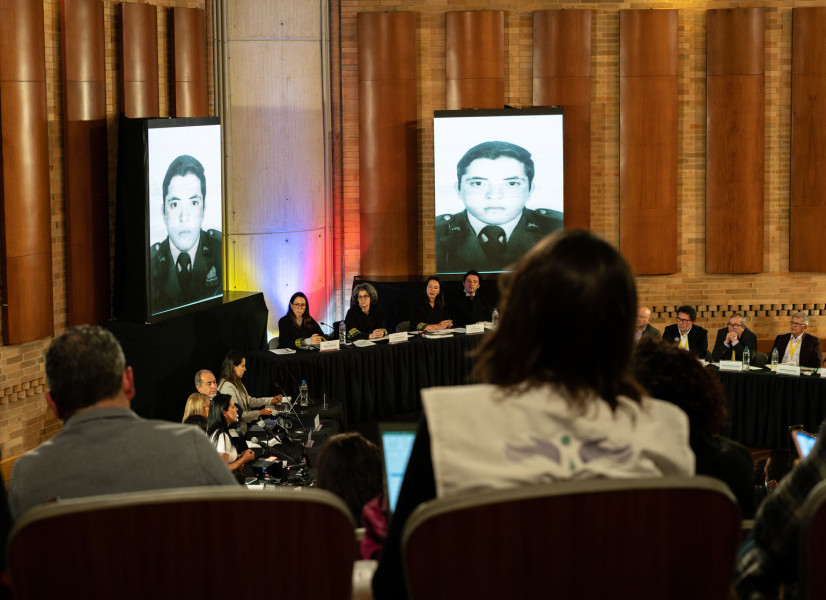
PHOTO: JEP magistrates and members of the FARC secretariat listen to a victim's testimony during the first Acknowledgment Hearing of Macrocase 01 in June 2022. (Maria Margarita Rivera/ICTJ)
VIDEO: El Espectador

