1519 results

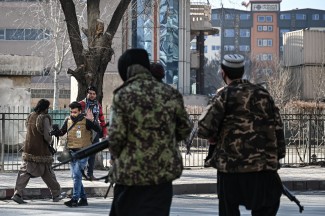
Since the Taliban seized control of Afghanistan in August 2021, the regime has put in place a series of policies severely restricting independent media and giving it all but total control over news outlets and their content. Kobra Moradi is a lawyer and researcher working with Afghanistan Human Rights and Democracy Organization and author of the recent report, Afghan Media Under the Taliban: Restrictions and Violations. ICTJ sat down with the author to learn more about what impact these restrictions have had on journalists and the free press, and the important role media can still play in such a repressive regime.

For 21 years, the people of The Gambia lived under the dictatorship of military strongman Yahya Jammeh. Now, The Gambia is working to step up to the challenge of unpacking the past, building a brighter future, and ensuring that it never relapses into repression, violence, and exclusion. The ICTJ spoke with Dr. Baba Galleh Jallow and Musu Bakoto Sawo, the Executive Secretary and Deputy Executive Secretary of the TRRC, respectively, to hear their insights about their work and how the TRRC can build upon other efforts to put victims at the forefront of The Gambia’s transformation .

In the summer of 2009, ICTJ’s Research Unit completed a major research project on the relationship between transitional justice and development, two fields that until now have proceeded in isolation from one another. In May 2009, In May, Pablo de Greiff and Roger Duthie sat down with...

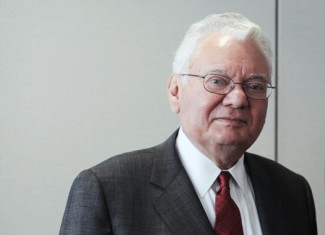
Thomas Buergenthal, Holocaust survivor and former judge of the International Court of Justice, is one of the world's most distinguished jurists. In conversation with ICTJ President David Tolbert, Judge Buergenthal shares his own personal story of surviving the Holocaust as a young boy, and reflects on the changing landscape of transitional justice around the world

This briefing paper assesses the situation in Ukraine with respect to democratic reforms being undertaken in the country following the mass uprising that ousted former President Viktor Yanukovych in February 2014. It examines issues of corruption and impunity, as well as the historica...

Though not a state party to the Rome Statute, Cote d’Ivoire accepted the jurisdiction of the ICC through an ad hoc declaration in April 2003, and in December of 2010—in the wake of the post-election crisis—reaffirmed that declaration. It has been more than one year since Cote d’Ivoire began a critical transition from a decade-long civil war that divided the country and led to widespread human rights violations, forced displacement, and loss of civilian lives and property.

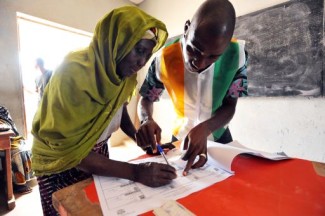
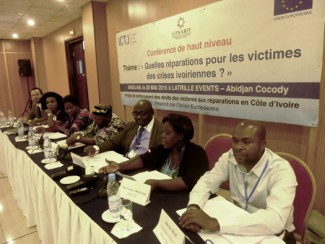
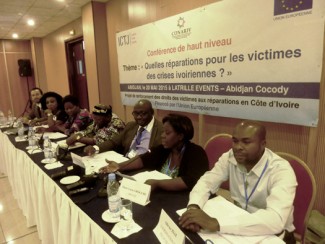
Nearly three years after violence in Cote d’Ivoire claimed the lives of over three thousand civilians and displaced hundreds of thousands, victims have yet to receive adequate reparation for the harm they suffered. ICTJ convened victims’ organizations, civil society, government officers and others to assess how the country should move forward to ensure victims see their right to reparation fulfilled.

ICTJ recently facilitated consultations on reparations policy between victims of the Ivorian crisis and the National Commission for Reconciliation and Compensation for Victims in Abidjan, Côte d’Ivoire.

On January 15, 2019, victims of the 2010-2011 post-election violence in Côte d'Ivoire were shocked, yet again, to learn that the Trial Chamber I of the International Criminal Court in The Hague had acquitted former President Laurent Gbagbo and the former Youth Minister Charles Blé Goudé of crimes against humanity allegedly committed during the crisis.

The Ivoirian government has a critical opportunity to define and implement a reparations policy that responds to the needs of the most vulnerable victims of the political, military and social crises experienced by Côte d’Ivoire between 1999 and 2012, according to the International Center for Transitional Justice (ICTJ).

In Cote d’Ivoire, avenues for education system reform are limited. To help youth find their voice, ICTJ and UNICEF facilitated an innovative truth-telling project led by Ivorian young people themselves. The result: an exploration of the unique experiences of young people during the conflict, told through radio broadcasts, public discussions and reports to government officials.

As the United States and Colombia near the signing of a free-trade agreement and resolve differences over labor rights and other issues, the problematic extraditions of paramilitaries accused of savage crimes committed during the years of counter-insurgency remain far from the spotlight.

This Brief of Amici Curiae is respectfully submitted by several human rights and torture treatment organizations pursuant to Federal Rule of Appellate Procedure 29 and District of Columbia Circuit Rule 29. The Brief is filed in support of the Plaintiffs-Appellants and seeks the revers...

A new briefing paper from the International Center for Transitional Justice provides guidance for national courts issuing decisions on redress of human rights violations involving sexual violence. It encourages judges, advocates and prosecutors to consider the full range of possible forms of redress when ordering reparations for victims, to make use of relevant national and international decisions in interpreting domestic laws, and to pay particular attention to how sexual violence may affect different victims.

In the quest to bring perpetrators of massive crimes to justice, international courts should be considered only as a last resort. Efforts to establish rule of law require the development of national capacity to prosecute the most serious crimes. On 25 and 26 October 2012, leading international actors from the judicial, rule of law, and development sectors will convene at the Greentree Estate in Manhasset, New York for the third Greentree Conference on Complementarity. The meeting aims to examine the needs of and challenges to national prosecutions for the most serious crimes in four countries: Ivory Coast, the DRC, Colombia, and Guatemala.

In war-torn Yemen, COVID-19 presents an imminent danger to the country’s 30 million people, 80 percent of whom rely on humanitarian aid to survive. For more than five years, brutal conflict has devastated the country and its economy, infrastructure, and public services including the health care system. By most accounts, the likelihood is high that the disease will spread through Yemen as the number of cases in neighboring countries continues to grow.

This paper examines the links between education and transitional justice initiatives in contexts affected by conflict. It argues that conceptually there can be meaningful mutual reinforcement between the educational goal of participation and the transitional justice goals of recogniti...

This paper examines the links between education and transitional justice initiatives in contexts affected by conflict. It argues that conceptually there can be meaningful mutual reinforcement between the educational goal of participation and the transitional justice goals of recogniti...

This paper discusses the significance of the trials of Saddam Hussein and his close associates held by the Supreme Iraqi Criminal Tribunal. It examines the challenges faced by the Tribunal - including concerns that the process was dominated by the U.S. government (hence undermining t...

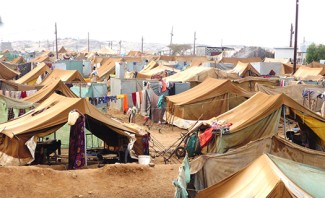
The crime of forced displacement has been a widespread practice in Colombia’s internal armed conflict for several decades. However, forced displacement cannot be reduced to an inherent or unintended effect of the conflict. The armed actors in the Colombian armed conflict—the army and ...

This paper is concerned with the relationship between criminal justice and displacement that has taken place as a result of serious violations of international humanitarian law, and considers these issues within the context of justice efforts in the former Yugoslavia. It argues that i...

This paper examines the crime of forced displacement from the perspective of both international and national legal frameworks. The crime of forced displacement is a notion that comes from international law. Indeed, an international legal framework has developed with the instruments an...

On August 24, 2009, U.S. Attorney General Eric Holder announced that he was appointing Assistant U.S. Attorney John Durham to conduct a preliminary review into the possibility that federal laws were violated in the interrogation of specific detainees outside of the United States. The ...

The report documents that practices that included slamming detainees into walls, extended sleep deprivation, suspending them by the arms, forced nudity, threats, prolonged shackling in uncomfortable positions and disrespect of the Qur'an, were the result of officially sanctioned polic...

Many in Colombia are also interested in learning from international experiences where criminal accountability measures were applied to pursue justice after massive human rights violations, like in Bosnia and Herzegovina, Cambodia, Sierra Leone and East Timor. With the aim of promoting an exchange of ideas on what lessons could be useful for Colombia, the ICTJ will be holding a conference in Bogotá on November 24th.