
New York, November 12, 2024—In countries where state institutions have limited reach, customary and informal justice is often the most common way in which people resolve disputes and seek justice. Given its prominence, it is considered to be an important element of a people-centered approach to building peaceful, just, and inclusive societies. An understanding of the relationship between customary justice and transitional justice, however, remains underdeveloped.
Today, ICTJ is releasing a new report that provides valuable empirical, qualitative research on the topic, in the context of South Sudan. The report, “‘Some Level of Peace’: Addressing Intercommunal Violence Through Customary Justice in South Sudan,” is based on dozens of interviews with stakeholders including chiefs, community leaders, educators, civil society representatives, and lawyers.
The report argues that while customary justice was not intended to deal with serious human rights violations linked to intercommunal conflict, it can potentially play an important role in resolving disputes and repairing relationships, including through practices of acknowledgment, compensation, and accountability. There is, however, a level of complexity to the violence and a lack of clarity on customary justice’s proper role that limits its value.
“In countries like South Sudan that are grappling with years of conflict and weak state institutions, customary justice mechanisms face significant challenges related to security, gender discrimination, politicization, and limited capacity to enforce decisions,” explained Agatha Ndonga, ICTJ’s head of program in South Sudan and author of the study. “Still, these local-level mechanisms are a main source of justice for the population and may have the potential to complement a national-level transitional justice process.”
The new report suggests that South Sudan’s transitional justice framework set up by the 2018 peace agreement provides opportunities to develop a hybrid approach that uses both customary and formal justice; takes into account the complexity of the violence; and offers clarity, support, and guidance for both government and customary justice actors. This potential is especially clear with regard to the Commission for Truth, Reconciliation and Healing (CTRH), which is tasked with supervising customary justice processes in facilitating truth, reconciliation, healing, and reparation.
“Given the complexity and scale of the conflict and resulting grievances in South Sudan,” said Anna Myriam Roccatello, ICTJ’s deputy executive director and director of programs, “complementarity between the CTRH and local peace and justice processes should be sought. The CTRH can issue guidance to traditional justice mechanisms and subnational peace processes on truth-telling efforts, in particular urging them to adhere to a victim-centered approach.”
The report concludes with recommendations for the CTRH and other stakeholders to address these challenges, take advantage of opportunities, and adapt customary justice in a victim-centered manner in the context of complex intercommunal violence. As one of the study’s respondents explained, “With necessary adaption, grounded in community perceptions and aspirations, customary justice has the potential to contribute to the realization of some level of peace in South Sudan.”
_______
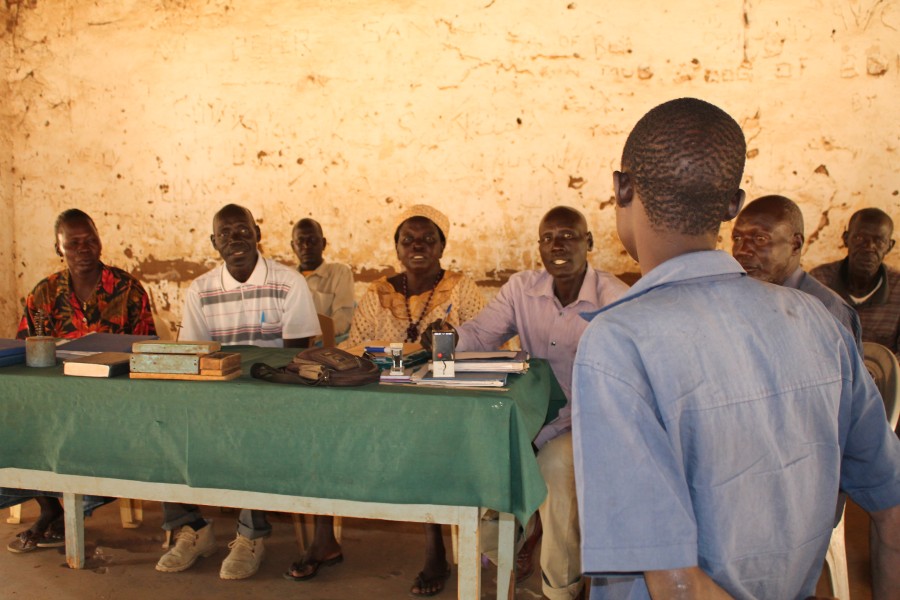
PHOTO: Community members take part in a UNDP-supported traditional court session in the city of Torit, in the state of Eastern Equatoria, South Sudan, in May 2016. (Photo@undp/southsudan)

