
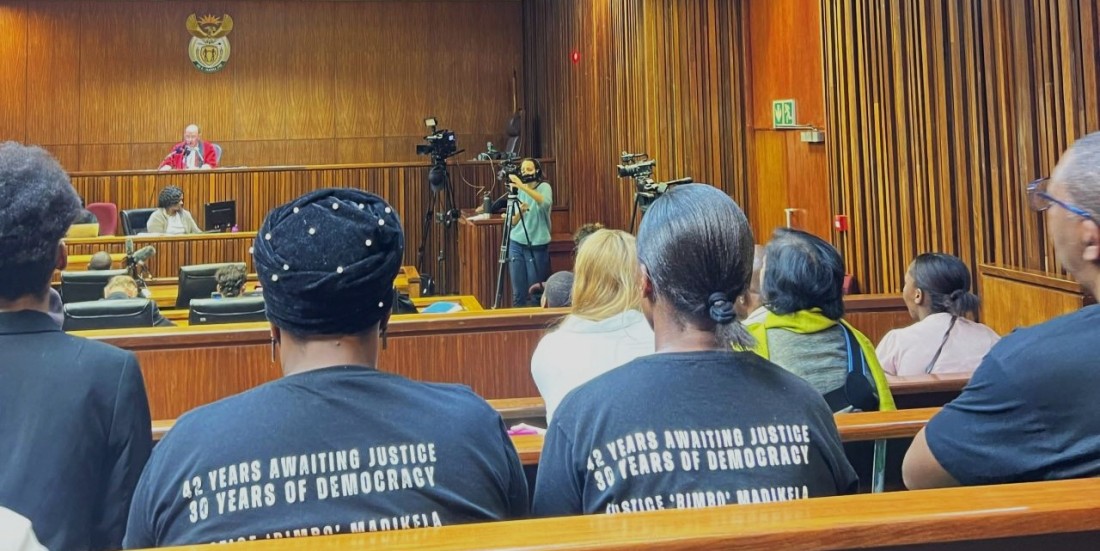

On April 14, 2025, the Johannesburg High Court handed down a landmark judgment. From his bench in courtroom 4D, Judge Dario Dosio dismissed the defense team’s objections to the inclusion of murder and apartheid as crimes against humanity charges in the indictment against two individuals accused of a deadly 1982 attack on anti-apartheid student activists. In so doing, the court cleared the way for crimes against humanity charges to be pursued in a South African domestic court for the first time. It also opened the door to the first ever prosecution of apartheid as a crime against humanity anywhere in the world.
February 15 of this year marked the 43rd anniversary of the deadly bombing attack by government security forces on four young activists from the Congress of South African Students (Cosas). The families of the victims (known as the Cosas Four) for years insisted that crimes against humanity charges be brought against the accused. They have maintained that the common law crimes of kidnapping and murder did not sufficiently capture the real gravity of the violations, which were perpetrated as part of a well-organized campaign of brutality and murder against those mobilizing against apartheid.
Lawyers for the families persuaded prosecutors that such international crimes could be prosecuted domestically in South Africa under customary international law. This was because customary international law had already prohibited murder and apartheid as crimes against humanity by 1982, when the bombing occurred.
Lawyers for the accused objected to the inclusion of these crimes in the indictment on the basis that the state’s right to prosecute them had expired under South Africa’s statute of limitations . Prosecutors and the families, who had intervened as amicus curiae, argued that, under customary international law, there is no statute of limitations for the core international crimes of genocide, crimes against humanity, and war crimes. This past April, the Johannesburg High Court agreed. Since then, the trial court has refused the lawyers of the accused leave to appeal, though they are seeking to petition the appeal court and are also seeking the recusal of the judge.
The Cosas Four families are aggrieved at how long it has taken for the state to pursue the case. All suspects in the crime have died except for two who are now both elderly. The families point to decades of inaction on the part of the authorities following the winding up of the Truth and Reconciliation Commission. Worse still, they believe, with good reason, that successive post-apartheid administrations have politically suppressed investigations into apartheid-era crimes.
Together with more than 20 other families, they filed a lawsuit in January against the South African president and government for constitutional damages to vindicate the violations of their fundamental rights to human dignity and justice. If awarded, these damages will be managed by an independent trust to support the families in monitoring the work of the justice authorities, taking legal action to advance justice, and engaging in memorialization activities. They are also seeking an order compelling the president to establish an independent commission of inquiry to investigate how hundreds of cases involving serious human rights abuses from South Africa’s past were abandoned. The president has agreed to establish such a commission. However, he is fighting the claim for constitutional damages in court, which will take up the case later this year.
More than 30 years into South Africa’s democracy, closure for most victims remains out of reach. However, they are fighting for their rights as victims and are demanding a reckoning, not only with apartheid-era perpetrators, but also with those who suppressed their cases in post-apartheid South Africa. The Cosas Four families and other victims of apartheid-era abuses deserve nothing less than a full accounting of the past.
___________
PHOTO: Family members of the Cosas Four await the judge’s decision in the Johannesburg High Court's courtroom 4D on April 14, 2025. (Mosangoaneng Leteane)

