
Since long before Russia’s full-scale invasion of Ukraine in 2022, Moscow has spread disinformation to justify its aggression. Russian President Vladimir Putin has repeatedly justified the invasion by falsely claiming that it was a pre-emptive strike against the threat of Ukrainian aggression, driven by neo-Nazi ideology and backed by the United States and its allies. These statements of the Russian leadership disguise their longstanding premises that Ukraine is, allegedly, not a sovereign nation, and its statehood is conditioned upon an alliance with Russia.
Experts and observers have attempted to decipher Russia’s true aims and identify pathways to end the war. Meanwhile, by leveraging social media and other digital platforms, Russia has continued to widely circulate false information seeking to diminish international support for Ukraine, especially in the United States.
Throughout the current conflict, Moscow has targeted right-wing media networks, leading several prominent conservative commentators to amplify Russian disinformation. For example, in 2022, commentator Tucker Carlson promoted fake stories on Fox News about Ukraine developing bioweapons. In 2024, U.S. federal prosecutors filed an indictment alleging that Russian state media funded a U.S. media company linked to a group of conservative influencers to produce videos aimed at weakening public support for Ukraine in the United States. Back in Russia, media outlets, de jure or de facto almost exclusively controlled by the state, have significantly contributed to propaganda domestically, justifying the aggression and atrocities against Ukrainians.
Toward the end of Joe Biden’s presidency, public support for Ukraine had eroded and become polarized. Immediately upon taking office, President Donald Trump began reversing U.S. foreign policy aimed at containing and contesting Russia’s aggression. In February, President Trump blamed Ukraine for starting the war and accused Ukrainian President Volodymyr Zelenskyy of being a dictator. In March, the United States halted all military aid to Ukraine until Ukrainian negotiators agreed to a 30-day ceasefire; suspended the efforts of U.S. national security agencies to counter Russian disinformation; and eliminated funding for a program that tracked Ukrainian children abducted and deported to Russia and Belarus, raising concerns that crucial evidence of these alleged war crimes may have been compromised. Days later, U.S. Special Envoy Steve Witkoff repeated Moscow’s false claims that popular votes have demonstrated that Ukrainians in Donetsk, Luhansk, Kherson, and Zaporizhzhia want to join the Russian Federation, ignoring the fact that the so-called referendums have been condemned and rejected by the international community due to their lack of independence, guarantees, and transparency.
The impact of these developments cannot be underestimated. The dramatic decline of democratic norms globally has thrown fuel on the fire lit by the ongoing digital transformation, both of which have made it more challenging to establish legitimate narratives that are shared within and across societies.
The right to truth is a core tenet of transitional justice, and victims cannot receive meaningful redress in its absence. Over the past few years, ICTJ has made it a strategic priority to ensure that the field can respond to contemporary challenges to the social value of truth, including the proliferation of disinformation through new communications technologies. At this stage, there can be little question that truth telling needs to be a substantial element of Ukraine’s transitional justice process. If, for example, Russia returns abducted Ukrainian children as part of the current peace negotiations, the false narratives used by their abductors to indoctrinate them will need to be thoroughly dismantled. Countering these narratives is not only valuable for Ukrainians. It is also crucial for buoying any democratic transformations in Russia and for establishing a more nuanced understanding of the history of Central and Eastern Europe.
Achieving a sustainable and just peace in Ukraine will require global policy actors to redouble their efforts to counter Russia’s rhetoric. Russia’s ultimate aim is to cast doubt on the idea that Ukraine is an independent country. No matter how the conflict ends, and no matter what terms Ukraine might be forced to accept in the ongoing negotiations, it is vital to ensure that Russia’s false narratives are not further legitimized. To establish as accurate a picture as possible, truth-telling efforts at all levels should elevate the tireless work of Ukrainian civil society actors to document crimes and disseminate firsthand testimonies from victims and many other forms of evidence. With the support of global policy actors, victims’ narratives—and the truth—have a chance to prevail.
_____________
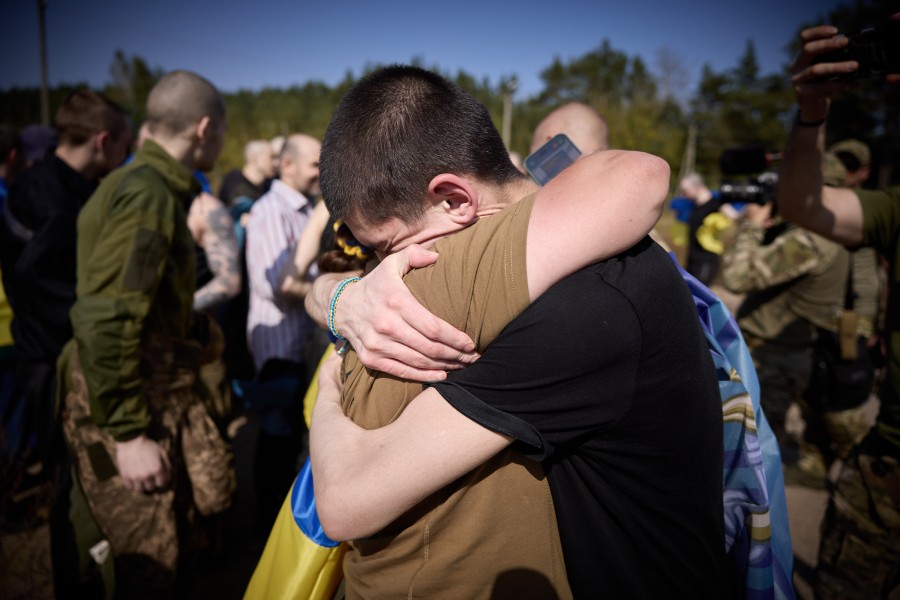
PHOTO: Servicemen from the Ukrainian armed forces, national guard, border patrol, and police force are returned home in a prisoner exchange between Ukraine and Russia on September 14, 2024. (Office of the President of Ukraine)

