Latest News

Explore our feature stories, opinion articles, and press releases.

ICTJ announces the departure of David Tolbert, President of the ICTJ, after eight years of service. David Tolbert was appointed president of ICTJ in March of 2010. He led the center’s evolution as it continued to pursue justice around the globe in changing times. ICTJ’s Executive Director, Fernando Travesi, will assume leadership of ICTJ following Tolbert’s departure at the end of March 2018.
Sixteen practitioners participated in the Intensive Course on Transitional Justice and Peace Processes held in New York from March 5 to March 9, 2018. Participants included leaders in their respective fields, including human rights law, community justice and legal services, peacebuilding, education, and humanitarian affairs. Selected course presentations, led by ICTJ experts and other specialists in the field, delved into cases of current, recent, and paradigmatic peace processes and questions of justice within a comparative context.
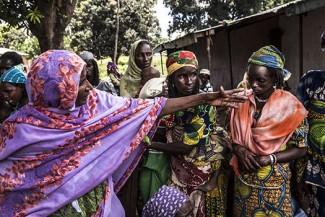
In recent months, the crisis in the Central African Republic (CAR) that erupted five years ago has seemed farther than ever from resolution. A new report by ICTJ, I Am 100% Central African: Identity and Inclusion in the Experience of Central African Muslim Refugees in Chad and Cameroon, offers important insights on how a higher political commitment to inclusion could help transform a volatile rebuilding process into a sustainable peace.
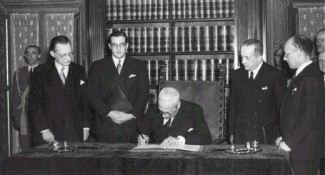
Constitutional reforms can be valuable in a transitional justice process, but their effectiveness depends on the degree to which they are woven into the social and cultural understanding of the country's legal framework.

Do the concepts and strategies of transitional justice have a role to play in the United States? Our 2017 Emilio Mignone Lecture asked that question, with Darren Walker, President of the Ford Foundation, and Sherrilyn Ifill, President and Director-Counsel of the NAACP Legal Defense Fund, joining ICTJ's David Tolbert in conversation. Watch the full discussion here.

Last month, the United Nations established a new mission in Haiti, focused on strengthening rule of law institutions and human rights reporting. Can it work with activists to challenge impunity? We sat down with Isabelle Clérié, a Haitian civil society organizer, about the mission, what it can accomplish, and how the past is understood in the country.

During the past month, over 400,000 members of Myanmar’s Rohingya Muslim community have been driven from their homes as part of an ethnic cleansing campaign led by the military. What lies at the root of the current violence, how is it connected to political transition, and does transitional justice have a role to play? ICTJ's Anna Myriam Roccatello answers those questions and more.

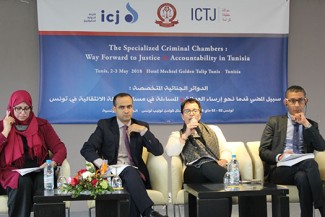
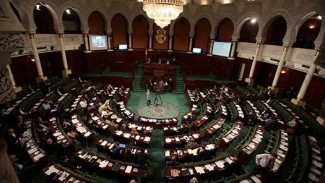
The International Center for Transitional Justice denounces the passage of Tunisia’s deeply flawed “Administrative Reconciliation” law, which grants amnesty to public officials who were involved in corruption during the dictatorship but who claim they did not personally gain from it.
Kenya is just days away from the 2017 general election, but challenges dot the horizon, including the recent assassination of an election official. ICTJ's Chris Gitari calls for a strong, accountable security sector and the implementation of the Truth, Justice and Reconciliation Commission Report.
Where does transitional justice stand in Sri Lanka? Kelli Muddell, Director of ICTJ's Gender Justice Program, explores the country's contested historical narratives.