20 results

A new ICTJ report urges the revitalization of Ukraine’s holistic transitional justice policymaking. Debunking the most common myths about transitional justice in Ukraine, the report presents the key legal, policy, and victim-centered arguments in favor of advancing a comprehensive transitional justice framework.

Despite earlier efforts to envision a national transitional justice policy, Ukraine remains overly cautious about establishing one. This report provides a robust substantiation of why Ukraine should revive its holistic transitional justice policymaking. In the first part, it debunks t...

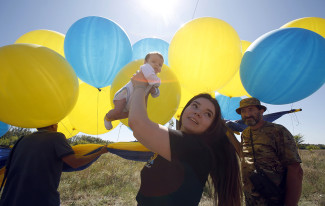
A women holds up an infant in the air on sunny day outdoors, surrounded by yellow and blue balloons

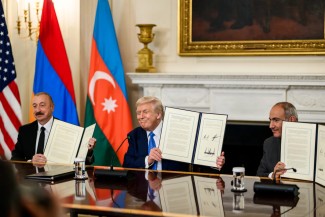
On August 8, Armenia and Azerbaijan signed the Joint Declaration on Future Relations. Hailed by some as a “historic peace deal,” it neither is a treaty nor ends the 37-year Nagorno-Karabakh conflict. Rather, it is a political framework that requires international support and attention.

Since long before Russia’s full-scale invasion of Ukraine in 2022, Moscow has spread disinformation to justify its aggression, disguising their longstanding premises that Ukraine is, allegedly, not a sovereign nation, and its statehood is conditioned upon an alliance with Russia. Countering these narratives is not only valuable for Ukrainians, but also for buoying any democratic transformations in Russia and for establishing a more nuanced understanding of the history of Central and Eastern Europe.

In the aftermath of armed conflict or repression, communities often struggle to rebuild social relations that have been damaged or destroyed by violence and abuse. Restorative justice can potentially play a valuable role in such societies, bringing together the people who have been harmed by crimes and the individuals responsible for those harms, often in the form of a dialogue, to address the offense and its consequences. A new ICTJ research report offers insight and guidance on the use of a restorative justice framework in responding to massive and grave human rights violations, drawing primarily from experiences in Colombia, Sierra Leone, Tunisia, and the Philippines’ Bangsamoro region.

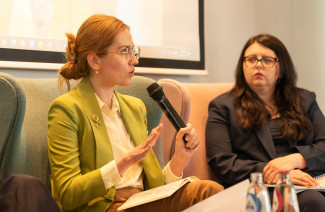
This research report offers guidance on the application of a restorative justice framework in contexts of massive human rights violations, including its advantages and challenges. Based on the experiences of Colombia, Sierra Leone, Tunisia, and the Philippines, the study examines how ...

A man and audience member holds his phone to record proceedings of panel on the stage in front of him.

Throughout 2023, ICTJ’s experts have offered their unique perspective on breaking news around the globe as part of the World Report. Their insightful commentaries have brought into focus the impact these events have on victims of human right violations as well as larger struggles for peace and justice. In this edition, we look back on the past year through the Expert’s Choice column.

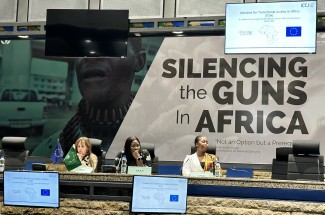
On October 25, the African Union (AU) and European Union officially launched their joint Initiative for Transitional Justice in Africa (ITJA) in Addis Ababa. The project will take place over a three-year period and will promote national transitional justice processes in Africa, in line with the AU Transitional Justice Policy and its roadmap. The ITJA has several unique features that, if embraced and advanced by all actors, have the potential to trailblaze a new and inspiring path to peace, justice, and sustainable development on the African continent.

Five years ago, in August 2018, to mark his 100 days in office, Armenian Prime Minister Pashinyan addressed a large rally in Yerevan’s Republic Square to officially announce his government’s intentions to incorporate transitional justice mechanisms into Armenian post-revolution reform agenda. Since then, Armenia has been pursuing a range of transitional justice initiatives alongside other democratic reforms, and it has made some limited headway, despite setbacks and major challenges including renewed conflict with Azerbaijan.

More than 20 years after the end of the Yugoslav Wars of the 1990s, Kosovo is still contending with unresolved ethnic tensions. Formerly an autonomous region of Serbia within the former Yugoslavia, Kosovo declared independence in 2008. Ethnic tensions were a root cause of the violent conflicts, during which an estimated 140,000 died and numerous atrocities were committed. ICTJ recently sat down with ICTJ's Anna Myriam Roccatello and Kelli Muddell to learn more about ICTJ's work and the present challenges to truth and justice in the country.