


629 results

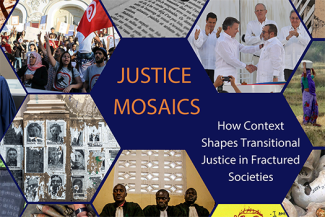
A new book by ICTJ titled Justice Mosaics: How Context Shapes Transitional Justice in Fractured Societies examines the challenges of responding to massive human rights violations in different and difficult circumstances in today's world.

The International Center for Transitional Justice (ICTJ) and the Committee of the Families of the Kidnapped and Disappeared in Lebanon (CFKDL) will release Windmills of Our Hearts, a new book of short stories by 15 women relatives of missing and forcibly disappeared persons in Lebanon. On June 1, ICTJ and CFKDL will host a public launch and book signing event at Dar el Wardieh in Hamra, Beirut.

In this era of technological transformation, it is critically important to develop digital strategies for documenting human rights violations, analyzing data for accountability or reparations purposes, and safely advocating for human rights online. This is particularly true in contexts where victims, human rights actors, and members of the media live in fear. To this end, ICTJ has recently led trainings for human rights activists in conflict-affected countries on open-source investigation tools to help them do their work more effectively.

ICTJ, in collaboration with the Center for Media Integrity of the Americas, the Cyrus R. Vance Center for International Justice, and the New York City Bar Association, recently hosted a screening of the Colombian documentary Después del Frío ("After the Cold"). Coproduced by ICTJ and Colombian journalist María Jimena Duzán, with the support of the Embassies of Sweden and Norway in Colombia, the film paints an intimate portrait of a nation seeking healing and transformation, where the scars of the past give way to hope.

Three human rights groups have joined together to publish a new English edition of Hatun Willakuy, a book presenting the abridged findings of Peru’s Truth and Reconciliation Commission, on its tenth anniversary. The book, which is available online, will allow a larger number of readers to benefit from the findings of Peru’s truth-seeking process.

New York, March 1, 2022—“There can be no peace in Syria until the rights of the wrongfully detained, disappeared, and their families are fully restored,” warns a new publication released today by the Bridges of Truth, a collaborative of eight Syrian civil society organizations and ICTJ. A Guide to...

New York, December 4, 2019—"Get ready to speak up and be heard because your voice matters!”—that is the message a new guidebook released today on transitional justice sends to Syrian youth. Produced by ICTJ and Dawlaty, a Syrian human rights organization based in Beirut, the guidebook introduces the concepts of transitional justice to young audiences in an engaging and interactive way while capturing the challenges of applying them in difficult contexts.

The end of 2022 in Venezuela was marked by signs of willingness from all parties to take concrete steps toward democracy. The government and the opposition resumed negotiations and agreed to allow the United Nations to manage a fund for billions of dollars of frozen assets, which would be gradually released to address the country’s humanitarian crisis. The United States authorized the Chevron Corporation to resume limited operations for importing Venezuelan oil. Finally, the 2015 National Assembly voted to end the opposition-led interim government. While these steps are initial ones to create the conditions for trust among the parties, they offer opportunities to improve the dire circumstances in which many Venezuelans currently live.

ICTJ releases a new briefing paper, “Reflections on Victim-Centered Accountability in Ukraine.” The paper examines the various actions that have been taken or are under consideration to investigate and prosecute war crimes and other human rights violations in Ukraine. It explores the myriad challenges they face and how tools from the field of transitional justice can be applied in tandem to deliver justice and reparation to victims and lay the foundation for a more inclusive and democratic Ukraine.

Since 2014, conflict in Yemen has caused hundreds of thousands of deaths, displaced millions, destroyed the economy, and exacerbated systemic marginalization, creating one of the world’s worst humanitarian catastrophes. Yet currently, transitional justice and reconciliation take up little space in the Yemeni political arena. In this context, ICTJ has released a new report that explores pathways to a just and sustainable peace in Yemen.