


510 results

On Friday, the United Nations hailed the progress made since 2014 in Tunisia in terms of transitional justice, underlining the importance of “enabling the transitional justice process to achieve its objectives." "The United Nations Resident Coordinator in Tunis, Diego Zorilla, congratulates all...

On March 22 in Geneva, we listened to the experiences of Syrians affected by attacks on schools. The Save Syrian Schools project presented the results of its one-year-long research—an unprecedented collaboration of 10 Syrian human rights organizations and the ICTJ.

Ten Syrian human rights organizations have been working in partnership with the International Center for Transitional Justice (ICTJ) to document and expose the long-term impacts of the attacks to and the destruction of schools in Syria. The project, Save Syrian Schools, will present its findings in a public hearing-style event in Geneva on March 22nd, at Forum Genève. The project works creatively to document human rights abuses and includes a public hearing-style event, multimedia, and high-level dialogue.

ICTJ announces the departure of David Tolbert, President of the ICTJ, after eight years of service. David Tolbert was appointed president of ICTJ in March of 2010. He led the center’s evolution as it continued to pursue justice around the globe in changing times. ICTJ’s Executive Director, Fernando Travesi, will assume leadership of ICTJ following Tolbert’s departure at the end of March 2018.

Sixteen practitioners participated in the Intensive Course on Transitional Justice and Peace Processes held in New York from March 5 to March 9, 2018. Participants included leaders in their respective fields, including human rights law, community justice and legal services, peacebuilding, education, and humanitarian affairs. Selected course presentations, led by ICTJ experts and other specialists in the field, delved into cases of current, recent, and paradigmatic peace processes and questions of justice within a comparative context.

In recent months, the crisis in the Central African Republic (CAR) that erupted five years ago has seemed farther than ever from resolution. A new report by ICTJ, I Am 100% Central African: Identity and Inclusion in the Experience of Central African Muslim Refugees in Chad and Cameroon, offers important insights on how a higher political commitment to inclusion could help transform a volatile rebuilding process into a sustainable peace.

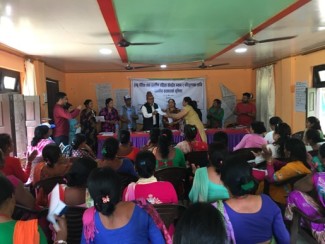
The ICTJ continues to support human rights victims in Nepal in their pursuit of justice, truth, reparations, and institutional reform. This briefing paper presents a summary of findings and recommendations from workshops that ICTJ conducted with women victims, as well as meetings it h...

In the aftermath of massive human rights violations, the voices of young people carry enormous potential: they can tell the truth about the past while offering new paths forward as their societies pursue peace and justice. However, if institutions want the insights of young people, they must avoid pre-formulated solutions and instead engage with youth on their own terms. A new guide released by ICTJ today aims to provide the tools necessary to do so, offering recommendations about how to responsibly and effectively gather statements from young people.

As human rights advocates and state representatives increasingly acknowledge the necessity of involving children in truth-seeking processes, there is a growing need for practical tools that facilitate children’s participation while prioritizing their protection. This statement-taking ...

Constitutional reforms can be valuable in a transitional justice process, but their effectiveness depends on the degree to which they are woven into the social and cultural understanding of the country's legal framework.