


8 results

Customary justice is the primary way in which most communities in South Sudan resolve disputes. Its ability, however, to deal with massive human rights violations is limited due to the complexity of intercommunal violence and a lack of clarity on its proper role. This report contends ...

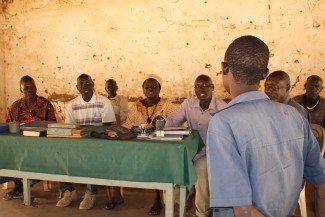
A man stands facing a table around which several men are seated.

In countries where state institutions have limited reach, customary and informal justice is often the most common way in which people resolve disputes and seek justice. Given its prominence, it is considered to be an important element of a people-centered approach to building peaceful, just, and inclusive societies. An understanding of the relationship between customary justice and transitional justice, however, remains underdeveloped. A new ICTJ report provides valuable empirical, qualitative research on the topic, in the context of South Sudan.

More than 20 years after the end of the Yugoslav Wars of the 1990s, Kosovo is still contending with unresolved ethnic tensions. Formerly an autonomous region of Serbia within the former Yugoslavia, Kosovo declared independence in 2008. Ethnic tensions were a root cause of the violent conflicts, during which an estimated 140,000 died and numerous atrocities were committed. ICTJ recently sat down with ICTJ's Anna Myriam Roccatello and Kelli Muddell to learn more about ICTJ's work and the present challenges to truth and justice in the country.

This study explores a transitional justice approach to the dilemma of foreign fighters in violent conflict. Such an approach can help center human rights in comprehensive responses to foreign fighters, and shift the current focus from security and punishment to justice and long-term p...

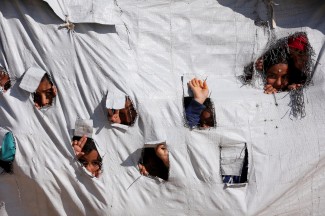
Image of Children looking through holes in a tent at al-Hol displacement camp in Hasaka governorate, Syria, on April 2, 2019.

New York, December 10, 2021—In contexts such as Afghanistan, Bosnia, Chechnya, Iraq, Somalia, and Syria, hundreds, sometimes thousands, of individuals have crossed national borders to engage in violent conflicts in which serious human rights violations and mass atrocities have been committed...

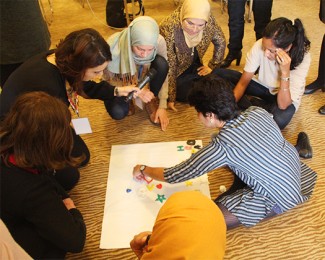
ICTJ’s Gender Symposium, held on February 2 to 4, 2019, in Tunis, Tunisia, brought together fearless women leaders working in 8 countries to advance the needs of victims and to bring gender issues to the center of transitional justice processes. What was achieved? What experiences cut across these diverse contexts? Kelli Muddell and Sibley Hawkins reflect on these questions and more in this short podcast.

Enforced disappearances are among the cruelest of crimes. To the kidnapping, torture, and in many cases, murder of the victim, perpetrators intentionally create fear and uncertainty about the fate of the missing person. Although men are predominantly targeted, the impact on women is severe and lasting.

Since 1990, 65 former heads of state or government have been legitimately prosecuted for serious human rights or financial crimes. Many of these leaders were brought to trial in reasonably free and fair judicial processes, and some served time in prison as a result. This book explores...