

255 results

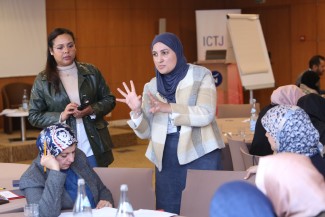
Human rights violations as well as any official response to them affect women’s lives in distinct, profound, and often unseen and unspoken ways. For a society grappling with mass atrocities, it is crucial to shed light on these diverse experiences, if they are ever to be acknowledged and repaired. Space must therefore be created for women victims to share their experiences. Libya is one such country. To help raise the voices of women victims and human rights defenders there, ICTJ has been collaborating with diverse women-led civil society organizations since 2019, bringing them together and helping them build their capacities.

Sexual violence against men and boys in times of conflict or repression is alarmingly common— and takes a markedly consistent form across contexts in terms of how it affects victims and societies as a human rights violation that is taboo to talk about. It has been committed in all cul...

Sexual violence against men and boys is alarmingly common amidst conflict or repression, but these crimes are often mishandled. A new ICTJ report examines how transitional justice efforts in South Africa, Kenya, Cambodia, and beyond have responded to the needs of male victims of sexual violence. What lessons can be drawn from these approaches?

This report focuses on “indirect victims” of human rights violations in Tunisia, namely, the wives, sisters, and children of political prisoners in Tunisia, who suffered discrimination, social exclusion, police violence, and harassment during the dictatorship. Presenting documentation...

As the world marks the third anniversary of the brutal war in Sudan, it is a moment to reflect on a conflict that rarely receives the media attention it deserves and to consider the millions of Sudanese caught in cycles of violence.

This report presents the findings from research on the needs and expectations of women survivors of sexual and gender-based violence in Nepal. Based on in-depth interviews, it explores what happened to these survivors during the country’s decade-long war (1996-2006), what they need no...

A cartoon illustration of a group of people

Lebanon’s ongoing “October Revolution” represents the largest decentralized, anti-government protest the country has seen at least since the end of the civil war in 1990. The demonstrations have brought thousands of Lebanese to the streets to condemn widespread corruption among the political class, paralyzing the country for weeks.

In what UN Women describes as the “shadow pandemic,” rates of violence against women have soared since the public health and economic crises brought about by COVID-19. With stay-at-home orders in place in countries around the world, women are more susceptible than ever to domestic violence. In countries affected by conflict or repressive rule, all forms of sexual and gender-based violence are on the rise. The ICTJ Gender Modules offer a timely tool to raise awareness about these issues and help develop gender-sensitive responses to them.

On International Women's Day, ICTJ Gender Justice Senior Associate Amrita Kapur highlights how insecurity affects women and is key to overcoming inequality across all dimensions of empowerment. "Without including institutional reform, we are condemning women to another century of inequality," she writes in this op-ed.

Since the Gambia's Truth, Reconciliation, and Reparation Commission (TRRC) began public hearings in January 2019, an important part of the country’s narrative has not yet come to light or been publicly acknowledged: the experiences of women. This report brings forward the voices of wo...